
Yes, you can learn to play piano on a keyboard. A good keyboard can teach notes, rhythm, chords, and songs. Pick one with full-size keys, touch response, and pedal support. An 88-key model feels closer to a real piano.
I’m Daniel Brooks. I have spent years testing keyboards, digital pianos, and beginner practice setups at home. New players ask this question all the time. They want to know if a keyboard can build real piano skill. That question makes sense. A keyboard costs less. It takes less space. It works well in apartments, dorm rooms, and busy family homes.
I have seen many beginners start on a keyboard and make real progress. They learned note names, scales, chords, rhythm, and simple songs. They built hand control too. They stayed with practice longer since a keyboard felt easy to use. Headphones helped at night. A small stand fit into tight rooms. That made daily practice much easier.
I have seen the other side too. Some people buy the wrong keyboard. The keys feel too light. The sound feels weak. The stand shakes. The pedal fails. Practice turns frustrating fast. The player thinks the problem is talent. In many cases, the real problem is the setup.
James Walker has written plenty of beginner tech-style buying guides. My angle is simpler. I test what works in real homes. A keyboard can work very well for piano study. The right model matters a lot. In this guide, I will show what to buy, what to skip, how to start, and how to avoid the usual mistakes.
Key Takeaways
– Yes, a keyboard can teach real piano basics.
– Touch-sensitive keys matter more than extra sounds.
– A 61-key model works for many beginners.
– An 88-key model fits long-term piano study better.
– A stand, bench, and pedal improve practice fast.
– Short daily practice beats random long sessions.
What It Means to Learn Piano on a Keyboard
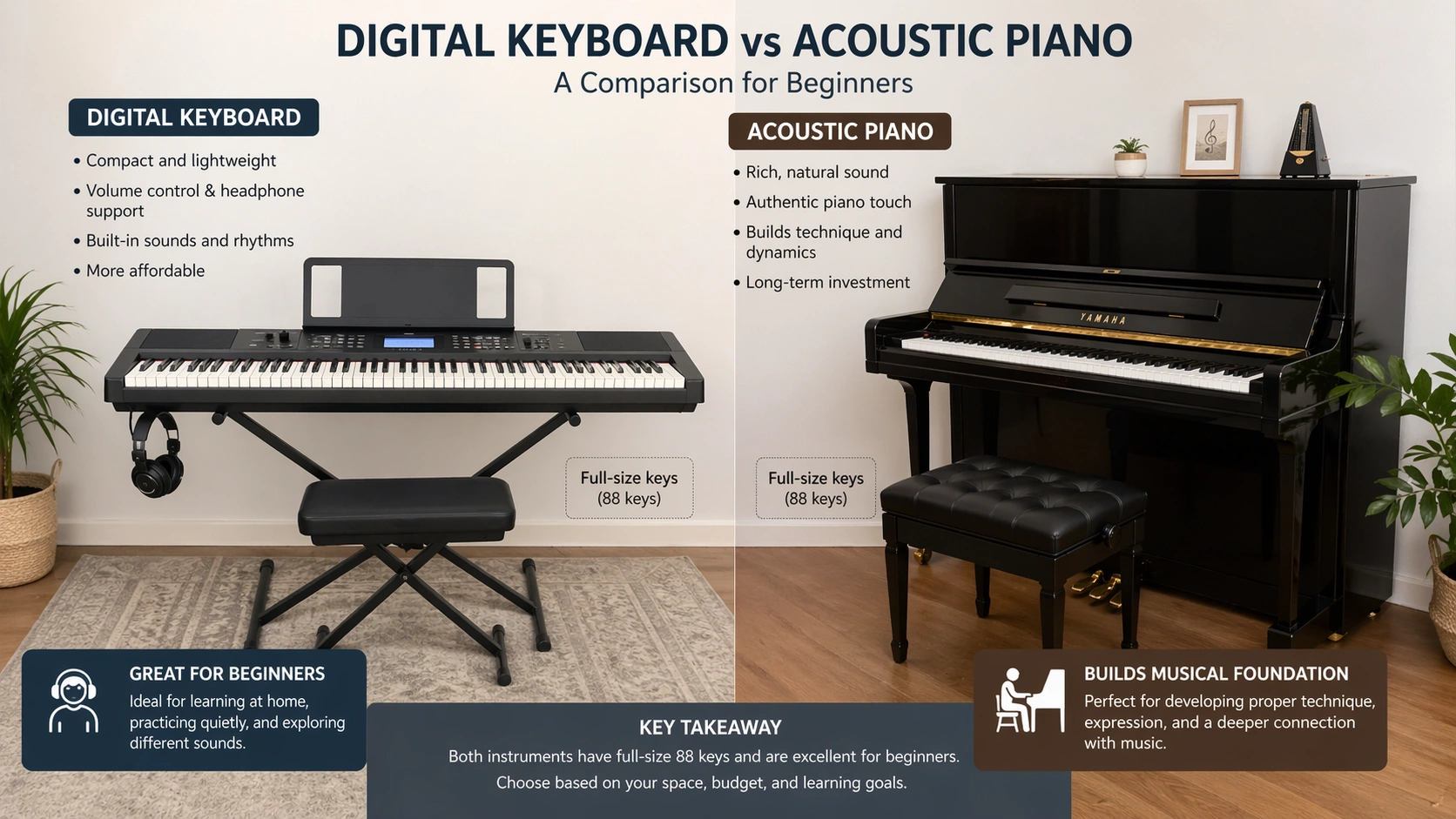
A keyboard uses the same note layout as a piano. C stays in the same place. Chords use the same shapes. Scales follow the same paths. That means your early skills transfer well. You can learn reading, rhythm, fingering, and coordination on a keyboard.
The main gap is feel. A real piano key pushes back more. Many cheap keyboards feel much lighter. That can affect finger strength and control. A better keyboard narrows that gap.
Why This Matters for Beginners
Most beginners do not quit from lack of talent. They quit from friction. The keyboard feels bad. The bench height is wrong. The pedal does not work. The sound feels thin. Practice gets annoying.
A better setup cuts that friction. You sit down faster. You practice more often. You hear mistakes sooner. You enjoy the process more. That steady loop builds progress.
How a Keyboard Helps You Learn Piano
Same key layout and note patterns
Every piano skill starts with the layout. White keys and black keys follow the same pattern on a keyboard. That lets you learn note names, intervals, chords, and scales from day one.
Touch response and finger control
Touch-sensitive keys react to how hard you press. That teaches soft and loud playing. It helps finger control too. Yamaha says touch-sensitive keys help players “grasp the essence of dynamics.”
Pedals, headphones, and apps
A sustain pedal adds longer note ring. Headphones help with quiet practice. USB and Bluetooth can link apps and lessons. Roland says Bluetooth can make learning “faster and more fun.”
How to Start Learning Piano on a Keyboard
Pick the right keyboard
1. Pick full-size keys first.
2. Pick touch-sensitive keys next.
3. Pick 61 keys for a low-cost start.
4. Pick 88 keys for deeper piano study.
5. Check for a sustain pedal jack.
6. Check for headphone or USB support.
Set up your practice space
1. Put the keyboard on a stable stand.
2. Set bench height near elbow level.
3. Keep both feet flat on the floor.
4. Put music at easy eye level.
5. Keep cables clear and neat.
Build a simple first-week plan
Day 1: Learn key names and finger numbers.
Day 2: Play five-finger patterns in both hands.
Day 3: Add a metronome and count aloud.
Day 4: Learn C major slowly.
Day 5: Learn three basic chords.
Day 6: Play one short melody.
Day 7: Record progress and repeat weak spots.
Best Keyboard Types Explained
| Type | Best For | Main Plus | Main Limit |
|---|---|---|---|
| 61-key touch-sensitive keyboard | New beginners | Lower cost and easy storage | Less range for harder music |
| 76-key keyboard | Players who want more range | More room for songs | Fewer entry options |
| 88-key digital piano | Serious piano study | Full range and better feel | Higher cost and more weight |
61 Keys vs 88 Keys: Full Comparison
A 61-key keyboard works for note reading, chords, scales, and many first songs. I often suggest it for kids, casual learners, and small rooms. It can serve well at the start.
An 88-key model gives the full piano range. That matters more as songs get harder. It matters more for classical music too. Alesis describes the Recital as having “88 full-sized semi-weighted keys.” That kind of setup feels closer to real piano work.
| Point | 61 Keys | 88 Keys |
|---|---|---|
| Beginner songs | Very good | Very good |
| Classical growth | Limited later | Best fit |
| Portability | Easier | Heavier |
| Budget | Lower | Higher |
Keyboard vs Acoustic Piano: Which One Fits Best?
| Feature | Keyboard | Acoustic Piano |
|---|---|---|
| Price | Lower entry cost | Much higher cost |
| Portability | Easy to move | Hard to move |
| Quiet practice | Headphones work well | No silent mode |
| Key feel | Depends on model | Best natural feel |
| Care | Low upkeep | Needs tuning |
Common Problems and Fixes
| Problem | Likely Cause | Fix |
|---|---|---|
| No sound | Headphones still plugged in or low volume | Check ports and raise volume |
| Keys feel flat | No touch sensitivity | Use a touch-sensitive model |
| Pedal not working | Wrong pedal type or polarity | Check pedal spec and restart |
| App will not connect | USB or Bluetooth setup issue | Retry pairing and test cable |
| Hands hurt fast | Bad bench height or tension | Raise seat and shorten sessions |
| Practice feels dull | No clear plan | Use a short daily routine |
Common Mistakes to Avoid
– Buying a keyboard with mini keys.
– Picking extra sounds over touch response.
– Skipping a proper stand or bench.
– Playing only songs and no basics.
– Rushing the tempo too soon.
– Ignoring rhythm and counting.
– Waiting for long free time blocks.
Pro Tips for Better Progress
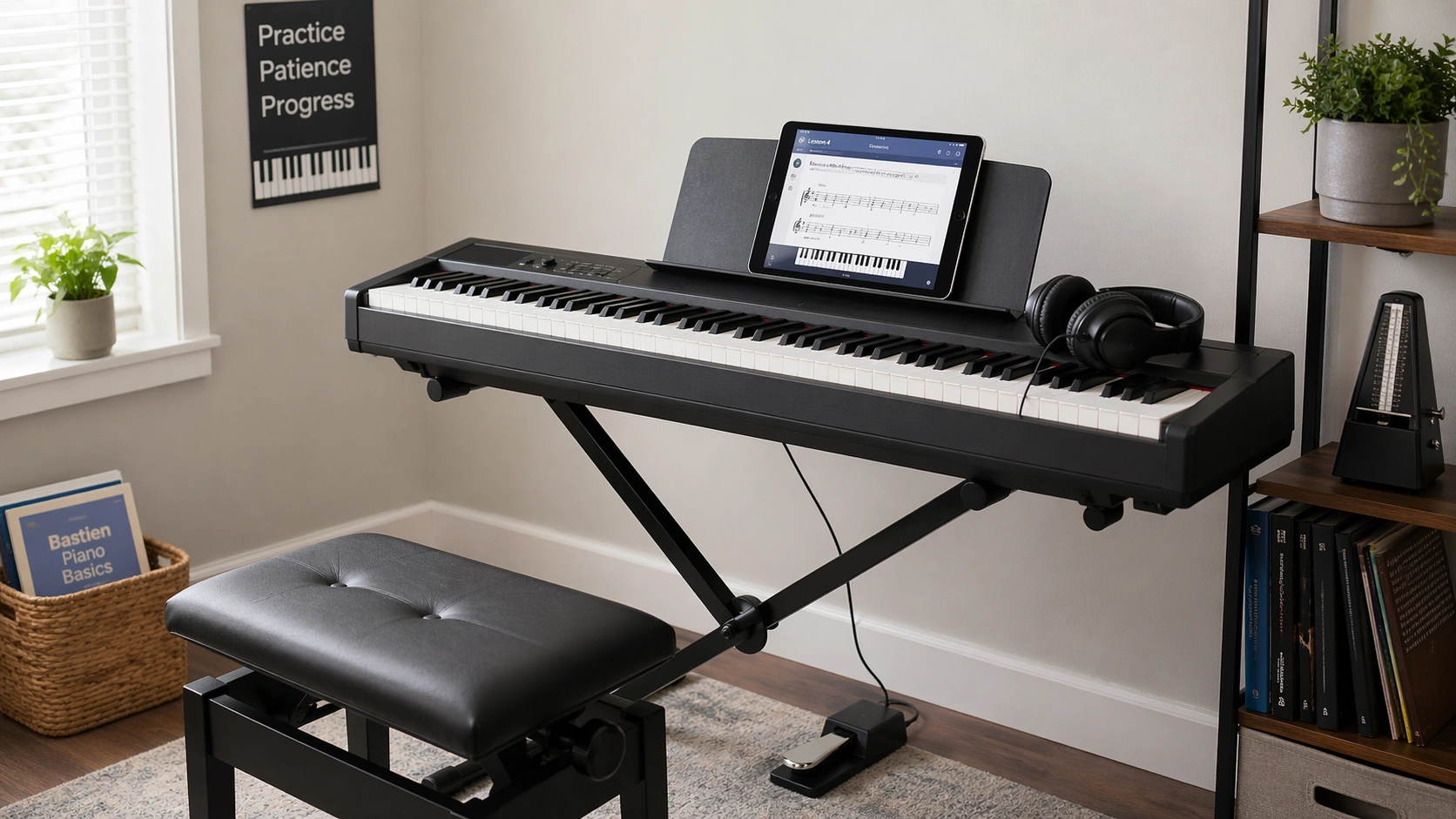
1. Practice 15 minutes each day.
2. Count aloud with a metronome.
3. Learn chords early.
4. Repeat hard bars in short loops.
5. Record one clip each week.
6. Keep wrists loose and shoulders soft.
7. Use headphones for late practice.
Tool Recommendations for New Players
Good tools make practice easier. They do not replace effort. They do cut friction fast.
| Tool | Why It Helps | Best For |
|---|---|---|
| Keyboard stand | Stable playing height | Every beginner |
| Bench | Better posture and reach | Every beginner |
| Sustain pedal | More natural phrasing | Growing players |
| Closed-back headphones | Quiet practice and clearer detail | Shared rooms and apartments |
Yamaha PSR-E383
Good first 61-key pick with touch-sensitive keys.
Authority links
Roland GO:PIANO GO-61P official page
Is It Worth Learning Piano on a Keyboard?
Yes, for many beginners it is worth it. A keyboard saves money. It saves space too. It allows quiet practice. That makes learning possible for many homes.
I would pick a good keyboard over no practice at all. Start with solid basics. Build skill now. Upgrade later if you want a fuller piano feel.
FAQ
Can you really learn piano on a keyboard?
Yes. You can learn notes, rhythm, chords, scales, and songs on a keyboard.
How many keys do I need to learn piano?
61 keys can work at the start. 88 keys fit long-term piano study better.
Do I need weighted keys as a beginner?
No. Yet weighted or semi-weighted keys can help your touch feel closer to a piano.
Can a cheap keyboard slow progress?
Yes. Mini keys, weak action, and no touch response can teach poor habits.
Can kids learn piano on a keyboard?
Yes. Kids often do well with a simple touch-sensitive keyboard and short lessons.
Can a keyboard replace piano lessons?
A keyboard can replace the instrument at first. Good teaching still helps a lot.
What features matter most in a beginner keyboard?
Look for full-size keys, touch response, a pedal jack, headphones, and a stable stand.
Final Thoughts
Can you learn to play piano on a keyboard? Yes, you can. Pick a keyboard with the right basics. Practice often. Keep your setup simple. Small daily sessions will take you much farther than waiting for the perfect piano.