

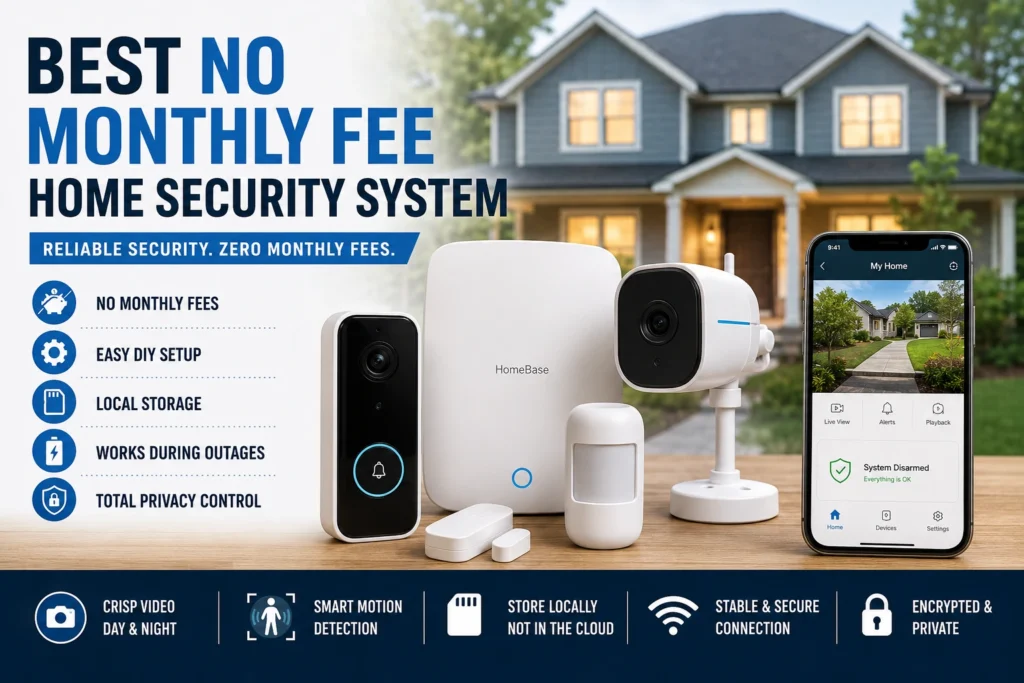
Quick answer: The best no-monthly-fee home security system depends on your priorities. For many homeowners, a local-storage system from Reolink or eufy is a strong choice because core video and storage features can work without a recurring subscription. For whole-home wired coverage, a Reolink PoE NVR system is especially attractive.
I’m James Walker, and at Diggons.com I focus on practical home security advice that helps you avoid paying for features you may not need.
The tricky part is that “no monthly fee” does not always mean the same thing. Some systems let you record locally but charge for advanced cloud features. Others let you use the alarm without a subscription but remove important remote alerts.
Below, I’ll break down what actually matters, which system types make the most sense, and the problems you should check before buying.
What “No Monthly Fee” Really Means
A no-monthly-fee home security system is a system that can provide useful security functions without requiring an ongoing subscription payment.
That can include local video recording, motion detection, alarm sensors, smartphone access, and live camera viewing. However, the exact free features vary by manufacturer.
This is why I recommend checking the feature list instead of assuming “no subscription” means everything is free forever.
| Feature | May Work Without Subscription | What to Check |
|---|---|---|
| Live camera view | Often yes | Check whether remote viewing is included |
| Local recording | Often yes | Check microSD, HomeBase, or NVR support |
| Motion alerts | Often yes | Check whether smart detection is included |
| Cloud video history | Often no | Many brands reserve this for paid plans |
| Professional monitoring | No | This normally requires a paid service |
How a No-Subscription Home Security System Works
A typical system combines cameras, sensors, an alarm hub, an app, and some form of video storage.
The important difference is where the system stores information and how alerts are delivered.
Cameras and Video Doorbells
Security cameras watch entry points, driveways, backyards, garages, and other areas around the home.
A good camera should provide useful night vision, clear motion detection, reliable connectivity, and enough storage for the footage you actually need.
Sensors and Alarm Devices
Door and window sensors detect opening events. Motion sensors watch rooms and hallways. Some systems also support glass-break sensors and dedicated sirens.
For a basic home alarm, sensors can be more important than having a camera pointed at every corner of the property.
Local Storage vs Cloud Storage
Local storage saves recordings on a device inside your home, such as a microSD card, security hub, or NVR.
Cloud storage sends recordings to remote servers. That can make off-site access convenient, but it may also introduce recurring fees.
Reolink currently advertises subscription-free recording and local storage options on several systems, while eufy promotes local security and local storage without a monthly fee on compatible products.
Self-Monitoring vs Professional Monitoring
With self-monitoring, you receive alerts and decide what to do next.
With professional monitoring, a monitoring center can respond to qualifying alarm events and contact you or emergency services according to the service terms.
This distinction is important. A system can have no monthly fee and still be useful, but it is not equivalent to paying for 24/7 professional monitoring.
What I Look For in a Reliable No-Fee Security System
Reliable Alerts
A camera that records perfectly but sends alerts ten minutes late is not very useful when someone is approaching your door.
Look for fast notifications, reliable mobile apps, and adjustable motion zones.
Local Storage
Local storage is one of the biggest reasons to consider a no-subscription system.
Reolink’s current Home Hub with Argus 3E, for example, supports local microSD storage and smart person, vehicle, and animal detection without requiring a monthly fee.
Backup Power
A security system should not become useless the moment your electricity goes out.
For important entry points, consider battery-powered devices, UPS backup for routers and NVRs, or systems with additional power options.
Strong Account Security
Your camera account is part of your home’s security perimeter.
Use a unique password, enable two-factor authentication when available, keep firmware updated, and avoid sharing your main account credentials with other people.
Weather Protection
Outdoor cameras need protection from rain, dust, temperature changes, and direct environmental exposure.
Do not assume every “outdoor” camera is equally suitable for an exposed installation.
For example, the eufyCam S3 Pro lists IP67 weather protection, while Reolink’s Argus 3E lists IP65 weather resistance.
Best No Monthly Fee Home Security System Options
Reolink Home Hub + Argus 3E — Best Budget-Friendly Option
This is one of the more interesting choices for people who want a straightforward wireless setup without a recurring recording subscription.
The current Home Hub with Argus 3E supports up to eight Reolink cameras, includes local storage support, and provides person, vehicle, and animal detection. The Argus 3E uses a rechargeable battery and can also be paired with a solar panel.
The system is especially appealing when you want simple coverage without running Ethernet cables throughout the house.
Another advantage is that Reolink lists WPA/WPA2/WPA3 support for the Home Hub Wi-Fi connection, along with AES-128 encryption for stored data.
eufy Security — Best Wireless Local-Storage Option
eufy is worth considering when privacy and local storage are high on your list.
eufy currently promotes local processing, local storage, and no monthly fee on compatible security products. Some systems can also expand local storage substantially through compatible storage hardware.
The eufyCam S3 Pro is a higher-end option with 4K video, solar power features, local storage, and support for Alexa, Google Assistant, and Apple Home compatibility.
Reolink PoE NVR Systems — Best for Whole-Home Wired Coverage
For a larger house, I generally prefer a properly planned wired camera system over filling the property with battery devices.
A PoE system can use Ethernet cables for both power and network connectivity. That reduces the number of batteries you have to maintain and can make continuous recording much easier.
Reolink’s RLK16-1200D8-A, for example, is a 12MP PoE system with person and vehicle detection, a 16-channel NVR, and a 4TB hard drive listed by the manufacturer. Reolink also lists it as requiring no subscription fees.
Recommended Devices
Reolink Home Hub with Argus 3E
Best for homeowners who want wireless cameras, local storage, smart detection, and no required monthly subscription.
eufyCam S3 Pro Security Camera System
A premium wireless option for buyers who prioritize 4K video, solar power, and local storage without a required monthly fee.
SimpliSafe 8-Piece Wireless Home Security System
A good option for people who want a conventional alarm-style system with sensors, keypad-based control, and optional professional monitoring.
No Monthly Fee vs Professional Monitoring: Which Is Better?
| Factor | Self-Monitoring | Professional Monitoring |
|---|---|---|
| Monthly cost | Usually lower | Usually recurring |
| Who responds first? | You | Monitoring center |
| Works while you sleep? | Only if alerts are noticed | Monitoring service can respond according to its terms |
| Best for | Budget-conscious users | Users wanting third-party response support |
| Internet dependence | Depends on system | Depends on system and monitoring setup |
There is no universal winner.
For a budget-conscious homeowner who is comfortable responding to alerts, self-monitoring can be a very reasonable choice.
For someone who wants another layer of response when they are asleep, away from home, or unable to answer an alert, professional monitoring can justify its recurring cost.
Wired vs Wireless Security System: Full Comparison
| Feature | Wired | Wireless |
|---|---|---|
| Installation | More work | Usually easier |
| Battery maintenance | Low | Higher for battery devices |
| Continuous recording | Excellent fit | Depends on model |
| Internet dependence | Can be reduced with local recording | Often more dependent on WiFi |
| Portability | Low | High |
| Best for | Permanent whole-home coverage | Renters and flexible installations |
For a new homeowner doing a long-term installation, I would lean toward wired cameras for important exterior coverage when practical.
For renters, apartments, or homes where cable installation is difficult, wireless cameras can be much easier.
Step-by-Step: How to Set Up a No-Monthly-Fee Security System
- Map your vulnerable areas. Start with the front door, garage, side entrances, driveway, and other likely entry points.
- Choose the right device type. Use cameras where visual verification matters and sensors where opening or movement detection is enough.
- Place the hub correctly. Avoid hiding a wireless hub inside a metal cabinet or behind thick walls.
- Connect and update everything. Install the official app, update firmware, and complete account security settings.
- Configure motion zones. Remove sidewalks, streets, tree branches, and other areas that create unnecessary alerts.
- Test day and night performance. Walk through the detection area in daylight and darkness.
- Test notifications. Confirm that your phone actually receives alerts while on cellular data and WiFi.
- Test the alarm. Make sure the system arms, disarms, and triggers correctly.
- Plan for power loss. Consider battery backup or a UPS for the network equipment and recording hardware.
How to Fix a Security Camera That Won’t Connect to WiFi
| Problem | What to Check |
|---|---|
| Camera cannot find WiFi | Check 2.4GHz compatibility and router distance |
| Camera repeatedly goes offline | Check signal strength, router health, and firmware |
| Setup fails during pairing | Reset the camera and repeat the manufacturer’s setup process |
| Live view is slow | Check upload speed and WiFi congestion |
| Connection drops outdoors | Move the camera closer or improve wireless coverage |
One of the biggest mistakes is assuming the camera itself is defective.
In many installations, the real problem is poor WiFi coverage, interference, router configuration, or an incorrect network band.
How to Fix Delayed Doorbell Notifications
Start by checking whether the doorbell has a strong connection.
Then confirm that battery-saving settings, phone notification permissions, and app permissions are not blocking alerts.
Also test the doorbell when your phone is connected to mobile data instead of your home WiFi. That can help identify whether the problem is with the phone, the router, or the doorbell itself.
What to Do When an Alarm Won’t Arm or Disarm
Check the app for an open door or window sensor.
A single sensor showing an incorrect state can prevent some systems from arming correctly.
Also check sensor batteries, hub connectivity, keypad status, and whether the system is in the correct mode.
If you repeatedly have to force the system into an armed state, do not ignore the problem. A security system that cannot arm reliably is a security problem by itself.
How to Reduce False Motion Alerts at Night
False alerts are often caused by poor camera placement rather than a bad camera.
- Point the camera away from busy roads.
- Avoid aiming directly at moving tree branches.
- Reduce unnecessary motion zones.
- Use person detection when available.
- Keep insects and spiders from covering the lens.
- Check whether headlights are crossing the detection area.
At night, shadows and headlights can create surprisingly convincing false triggers.
What to Do When a Smart Lock Becomes Unresponsive
Start with the battery.
A smart lock that becomes slow, inconsistent, or completely unresponsive may simply be running on low batteries.
Next, check the lock’s physical alignment. A deadbolt that is rubbing against the strike plate can put unnecessary strain on the motor.
Also check the app connection and firmware before assuming the hardware has failed.
What Happens During a Power Outage?
This is one of the most important questions people forget to ask before buying a security system.
A camera with local battery power may continue running while a WiFi router without backup power goes offline.
That means the camera itself may still have power but remote access may fail.
For a more resilient setup, consider battery-powered cameras, a UPS for the router, and local recording that can continue without cloud access.
Common Home Security Mistakes That Leave You Vulnerable
- Using the default password: Change it immediately.
- Ignoring firmware updates: Security updates matter.
- Installing cameras too high: Extreme height can make faces and other details harder to identify.
- Pointing cameras through windows: Glass reflections can ruin nighttime footage.
- Ignoring WiFi coverage: A premium camera is still unreliable with a weak connection.
- Using too many motion zones: More detection is not always better.
- Skipping backup power: A power outage can disable the network layer.
- Paying for unnecessary subscriptions: Always check which features actually require a plan.
Pro Tips for More Reliable Home Protection
Put your best camera at the most important entrance instead of spreading cheap cameras everywhere.
Use a door sensor on a low-visibility entry point even if you already have camera coverage.
Do not depend on one security layer. A camera can identify a person. A door sensor can confirm that an entry point opened. An alarm can create immediate audible deterrence.
For privacy-sensitive locations, carefully review which devices send footage to the cloud and which can keep recordings local.
For more practical home security guides, explore home security guides and our security camera guides.
Frequently Asked Questions
Can I have a home security system without paying a monthly fee?
Yes. Several systems can provide local recording, alarms, motion detection, and self-monitoring without requiring a recurring subscription. However, premium cloud features or professional monitoring may still cost extra.
Is a no-monthly-fee security system reliable?
It can be. Reliability depends more on device quality, installation, power backup, network stability, storage, and alert performance than on whether a subscription is required.
Do I need professional monitoring?
No. Self-monitoring can be enough for some households. Professional monitoring is more useful for people who want third-party response support rather than handling every alarm themselves.
Are security cameras without subscriptions worth it?
They can be, especially when the camera supports local storage and the features you actually need work without a paid cloud plan.
Can a security camera still record without WiFi?
Some cameras and NVR systems can continue local recording without an active internet connection. The exact behavior depends on the device and recording setup.
Are no-subscription security systems safer for privacy?
Not automatically. Local storage can reduce dependence on cloud storage, but you still need strong passwords, secure accounts, current firmware, and good network security.
What is the biggest downside of a no-monthly-fee system?
The biggest trade-off is usually that you are responsible for monitoring the system yourself and may not receive the same level of cloud storage or professional response services offered by subscription plans.
Final Verdict
The best no-monthly-fee home security system is not simply the cheapest system you can buy.
Look for reliable alerts, local storage, strong account security, weather protection, sensible installation options, and backup power.
For wireless local-storage security, Reolink and eufy are two options worth evaluating. Reolink also has a strong case for homeowners who want a larger wired PoE setup with local NVR recording.
The key is to choose a system whose essential security features continue working without forcing you into a subscription you never intended to pay for.