
Quick answer: For most U.S. homeowners, I would start with SimpliSafe because it combines professional monitoring, flexible plans, easy installation, and no long-term contract. ADT is a stronger choice when you want professional installation, while Vivint is better suited to premium whole-home security.
Choosing a monitored home alarm company is not just about finding the cheapest monthly plan. You want a system that still works when your internet goes down, your phone is unavailable, or an alarm happens at 2 a.m.
I’m James Walker, and for Diggons.com I focus on practical home-security buying advice, from alarm systems and sensors to cameras and smart locks. My goal is simple: help you choose protection that makes sense in a real home, not just on a sales page.
What Is a Monitored Home Alarm System?
A monitored home alarm system connects your security equipment to a professional monitoring service. When a sensor detects a break-in, fire, carbon monoxide event, or another supported emergency, the monitoring center receives the alarm signal and follows its response procedure.
That is different from self-monitoring. With self-monitoring, your phone receives the alert and you decide what to do next.
Professional Monitoring vs Self-Monitoring
| Feature | Professional Monitoring | Self-Monitoring |
|---|---|---|
| 24/7 monitoring center | Yes | No |
| You receive app alerts | Usually | Yes |
| Someone can respond while you are asleep | Yes | No |
| Monthly monitoring fee | Usually required | Often lower or optional |
| Best for | Hands-off protection | Budget-conscious users |
What Happens When an Alarm Goes Off?
A typical sequence is simple. A door sensor, motion detector, smoke detector, or other device detects an event. The system sends that signal to the monitoring service. The operator follows the company’s response process and may contact you, your emergency contacts, or emergency services depending on the event and service terms.
Why Professional Monitoring Matters
The biggest advantage is coverage when you cannot respond yourself. Imagine your phone is in another room, you are asleep, or you are traveling. A professional monitoring center can still receive the system signal and follow its emergency procedure.
The Best Monitored Home Alarm Companies I Recommend
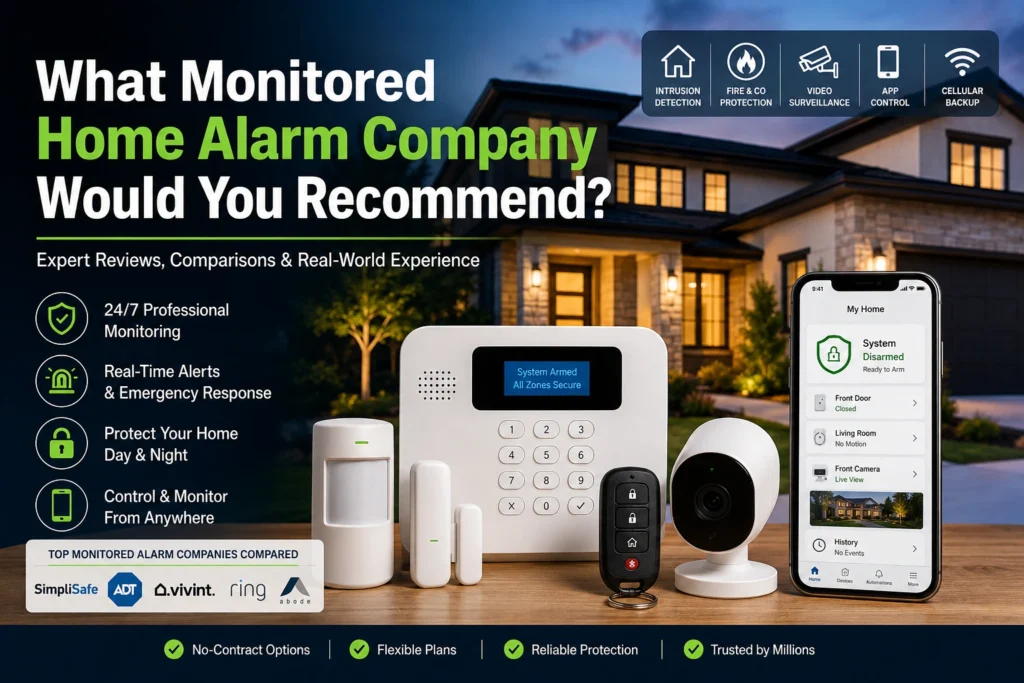
SimpliSafe — Best Overall for Most Homes
SimpliSafe is my first place to look for most homeowners who want professional monitoring without a complicated traditional security contract.
Its current monitoring lineup includes multiple service levels, with professional monitoring starting at a relatively accessible price point and higher tiers adding video-related and active-response features. SimpliSafe also advertises monthly plans without long-term contracts.
The biggest reason I like this approach is flexibility. You can build the system around door sensors, motion sensors, cameras, smoke protection, and other devices instead of being forced into a huge package.
SimpliSafe is especially attractive for homeowners who want DIY installation but still want professional monitoring available in the background.
ADT — Best for Professional Installation
ADT makes more sense when you want a traditional security company experience with professional installation and professionally managed monitoring.
That convenience comes with an important tradeoff: depending on the package, financing arrangement, and promotion, the total cost and contract terms can be considerably different from a DIY system.
Before signing anything, read the installation price, monthly monitoring fee, contract length, warranty, and cancellation terms. The Federal Trade Commission specifically recommends checking these details before committing to a home security service.
Vivint — Best for Premium Whole-Home Security
Vivint is the option I would examine when the priority is a more premium, professionally installed system with integrated security devices.
It is particularly appealing to homeowners who want a technician to handle installation and want a more complete system rather than a few basic sensors.
The tradeoff is cost. Vivint is generally a better fit for buyers who are comfortable paying more for installation, equipment, and a more managed experience.
Ring Alarm — Best for Budget-Friendly Monitoring
Ring is worth considering when you already use Ring cameras or doorbells and want to add alarm protection to the same ecosystem.
As of 2026, Ring’s subscription structure uses Ring Protect plans. Ring Protect Pro is currently listed at $19.99 per month and includes 24/7 professional monitoring for eligible alarm systems. Ring also offers lower-cost plans and a separate Virtual Security Guard option.
One thing I would watch carefully is the plan structure. Ring changed its plan names in January 2026, so older articles can show outdated plan names and pricing.
Abode — Best for Flexible Smart-Home Integration
Abode is a strong alternative for homeowners who want more flexibility around smart-home integrations and self-monitoring.
It can be particularly interesting for smaller homes, apartments, and users who want to combine security with a broader smart-home setup. Its compatibility options are one of its biggest strengths.
Monitored Home Alarm Companies Compared
| Company | Best For | Installation | Monitoring | Contract Flexibility |
|---|---|---|---|---|
| SimpliSafe | Most homeowners | DIY or professional | Professional and self-monitoring options | High |
| ADT | Professional installation | Professional | Professional | Lower |
| Vivint | Premium whole-home security | Professional | Professional | Varies by package |
| Ring | Budget and Ring users | DIY | Optional professional monitoring | High |
| Abode | Flexible integrations | DIY | Flexible | High |
How Professional Home Alarm Monitoring Works
Step 1 — A Sensor Detects an Event
A door or window sensor may detect an opening. A motion sensor may detect movement. A smoke or carbon monoxide device may detect a life-safety event.
Step 2 — The Monitoring Center Receives the Signal
The alarm system sends the event through its available communication path. Systems with cellular backup can provide an additional connection when normal internet service is unavailable.
Step 3 — The Event Is Verified
The monitoring company follows its procedure for the specific alarm. Depending on the service, operators may use alarm information, communication with you, or compatible video information to determine what is happening.
Alarm.com, for example, describes a process in which an event is detected, the monitoring center evaluates it, and emergency assistance is contacted when appropriate.
Step 4 — Emergency Help Is Contacted
Depending on the type of emergency and your service agreement, the monitoring center may contact police, fire, or EMS. Exact response rules vary, so never assume every alarm automatically results in an emergency dispatch.
DIY vs Professional Installation: Which Should You Choose?
DIY Installation
DIY systems are usually easier to install and give you more control over sensor placement. They can be a great fit for apartments, rentals, and homeowners who are comfortable following setup instructions.
The main risk is incorrect placement. A badly positioned motion sensor or door contact can create false alarms or leave an important entry point uncovered.
Professional Installation
Professional installation removes much of that setup work. It can also make sense for larger homes, complicated layouts, or homeowners who simply do not want to spend time installing sensors.
Which Is Better for Your Home?
| Situation | Better Choice |
|---|---|
| Small apartment or rental | DIY |
| Large multi-level home | Professional installation |
| Simple sensor setup | DIY |
| Complex whole-home installation | Professional installation |
| Lowest upfront installation cost | DIY |
How Much Does Professional Home Alarm Monitoring Cost?
There is no single price that applies to every home. Your total cost can include the monitoring plan, equipment, professional installation, video subscriptions, storage, and other optional services.
For example, Ring currently lists its Ring Protect Pro plan at $19.99 per month in the U.S. with eligible professional alarm monitoring included. SimpliSafe’s current service lineup includes plans ranging from lower-cost professional monitoring to significantly more expensive active-protection tiers.
Monthly Monitoring Fees
This is the recurring amount you pay for monitoring and other included services. Compare the features, not just the advertised monthly price.
Equipment and Installation Costs
A low monthly fee can look attractive until you add a keypad, sensors, cameras, locks, smoke detectors, and installation.
Contract and Cancellation Costs
This is where buyers often get surprised. Some companies are flexible and month-to-month. Others may use longer service agreements, equipment financing, or cancellation conditions.
Hidden Fees to Check Before Signing
- Installation charges
- Activation fees
- Equipment financing
- Early cancellation charges
- Local permit fees
- False-alarm fines
- Optional camera or cloud-storage subscriptions
The FTC recommends asking about installation costs, monitoring fees, contract periods, discounts, warranties, cancellation rights, and local false-alarm requirements before agreeing to a system.
Common Problems With Monitored Alarm Systems and How to Fix Them
| Problem | Likely Cause | What to Check |
|---|---|---|
| Alarm won’t arm | Open sensor or system fault | Check every door/window sensor and system status |
| False alarms | Sensor placement, pets, movement | Adjust sensor position and detection settings |
| System fails during outage | No backup power or communication | Check battery and cellular backup |
| App alerts are delayed | Connectivity or app issue | Check WiFi, cellular connection, and app status |
| Camera won’t connect | Weak WiFi or incorrect setup | Check signal strength, credentials, and device reset steps |
Alarm Won’t Arm
Start by checking whether a door or window sensor is still showing as open. Also check for low batteries, communication errors, or a sensor that has moved away from its intended position.
Alarm Keeps Triggering False Alerts
False alarms are frustrating and can become expensive if your local area charges response fees. Common causes include poor motion-sensor placement, pets entering the detection zone, loose door contacts, and environmental movement.
Make one change at a time so you can identify the real cause rather than changing multiple settings at once.
System Stops Working During a Power Outage
A reliable system should have a backup strategy. Look for battery backup and, where available, cellular connectivity that does not depend entirely on your home internet connection.
App Notifications Are Delayed
Check your internet connection, phone notification settings, battery-saving restrictions, and the security system’s communication status. A delayed phone notification does not automatically mean the alarm itself failed.
Security Camera Won’t Connect to WiFi
Move the camera temporarily closer to the router, verify the WiFi password, restart the device, and check whether your router is using a supported network configuration.
For outdoor cameras, also check whether the device is within reliable WiFi range and protected from weather in accordance with the manufacturer’s installation requirements.
Common Home Security Mistakes to Avoid
- Choosing a company only because it has the lowest monthly price.
- Ignoring cellular backup and battery backup.
- Installing motion sensors where pets or moving objects repeatedly trigger them.
- Leaving old batteries in sensors for too long.
- Using a weak password or skipping two-factor authentication.
- Failing to test the alarm after installation.
- Not reading cancellation and equipment terms.
- Assuming professional monitoring guarantees police or fire response in every situation.
What I Look For in a Reliable Monitoring Company
When I compare monitored alarm companies, I care more about reliability and clarity than a flashy sales page.
- Clear monitoring and cancellation terms
- Reliable communication paths
- Battery and cellular backup
- Responsive apps and hardware
- Good sensor coverage
- Reasonable false-alarm controls
- Strong account security
- Transparent pricing
- Useful emergency monitoring options
Best Home Alarm Company for Different Situations
| Your Priority | My Pick | Why |
|---|---|---|
| Best overall balance | SimpliSafe | Flexible equipment, professional monitoring, and easy setup |
| Professional installation | ADT | Done-for-you installation and traditional professional monitoring |
| Premium whole-home security | Vivint | Strong professionally installed ecosystem |
| Budget-friendly Ring ecosystem | Ring Alarm | Useful option for existing Ring users |
| Flexible smart-home integration | Abode | Broad integration and flexible security options |
Recommended Home Security Equipment
SimpliSafe Wireless Home Security System
A practical starting point for homeowners who want a dedicated alarm system with sensors and optional professional monitoring.
Ring Alarm Security Kit
A good fit for homeowners already using Ring cameras or doorbells who want alarm sensors and professional monitoring in the same ecosystem.
How to Choose the Right Monitoring Company
- Decide whether you want DIY or professional installation.
- Choose the devices your home actually needs.
- Compare the full monthly cost, not just the starting price.
- Check whether cellular and battery backup are included.
- Read the contract and cancellation terms.
- Confirm what happens when an alarm is triggered.
- Check smart-home compatibility if you already use Alexa, Google Home, or another supported platform.
- Test the entire system after installation.
For more practical guides, you can also explore the Diggons home security guides.
Pro Tips for More Reliable Home Alarm Monitoring
Test your system regularly. A sensor that worked six months ago is not automatically reliable today.
Replace batteries before they completely fail. Keep the monitoring app updated and use two-factor authentication on your account.
Review false alarms instead of simply disabling the sensor. Repositioning one motion detector can be much safer than turning it off permanently.
Also keep your emergency contact information current. If your monitoring company has old contact details, a perfectly functioning alarm system can still become frustrating during a real emergency.
FAQ
Is professional home alarm monitoring worth it?
For many homeowners, yes. The main benefit is having a monitoring center available when you cannot respond yourself. It is especially useful if you travel often, live alone, or want added protection while sleeping.
What is the most reliable home alarm company?
There is no single company that is best for every home. My strongest starting point for most homeowners is SimpliSafe, while ADT and Vivint are better suited to people who prefer professional installation and a more managed service.
How much does home alarm monitoring cost?
Pricing varies by company and plan. As of 2026, Ring lists professional alarm monitoring through Ring Protect Pro at $19.99 per month, while SimpliSafe offers multiple monitoring tiers at different prices. Always verify the current plan before purchasing.
Does professional monitoring work without WiFi?
It can, depending on the system. Look for cellular backup if you want protection when your normal internet connection fails.
Do monitored alarm companies automatically call police?
Not necessarily in every situation. The exact response depends on the provider, alarm type, verification process, local rules, and your service agreement.
Can I use professional monitoring without a contract?
Yes, some companies offer month-to-month professional monitoring. SimpliSafe, for example, currently advertises monitoring plans without long-term contracts.
What should I check before choosing an alarm company?
Check the monitoring fee, equipment cost, installation cost, contract length, cancellation policy, cellular backup, battery backup, false-alarm policy, emergency response procedure, and privacy protections.
Final Verdict
So, what monitored home alarm company would I recommend?
For most homeowners, I would start with SimpliSafe. It offers a strong balance of flexibility, professional monitoring, DIY installation, and straightforward service options.
ADT is a better choice when professional installation is important. Vivint is worth considering for a premium, professionally installed system. Ring Alarm is attractive for budget-focused buyers already invested in Ring devices, while Abode stands out for flexibility and integrations.
The best alarm company is not necessarily the one with the lowest monthly fee. It is the one that fits your home, gives you reliable communication during an emergency, and has pricing and terms you fully understand before you sign up.
For more home security comparisons and practical guides, visit Diggons.com home security resources.