

You can capture license plates at night, but only if your system has the right mix of hardware and setup. With a dedicated license-plate camera, good low-light tech, proper placement, and the right software, you can reliably read plates after dark. Ethan Carter from Diggons.com often points out that the difference between a blurry image and a clear plate is usually the camera choice and how it’s installed.
Think about what matters: lens, infrared or color night vision, angle, and distance. If you want usable plate data, you’ll need to match the camera to the location and traffic speed, then tune the software that reads the numbers. Small changes in mounting height or aiming can make a big difference, and routine checks keep the system working night after night.
Key Takeways
- Choose cameras with strong low-light features and proper optics.
- Position and aim cameras to match vehicle paths and speed.
- Use good image-processing software and perform regular checks.
How Nighttime Conditions Affect Camera Performance
Nighttime makes it harder to capture small, high-contrast details like license plate characters. Light level, direct glare, and falling precipitation each change how clearly a camera can focus, expose, and process a plate image.
Low Light Challenges
Low light reduces the camera’s ability to capture sharp details. Sensors collect fewer photons, so images become noisy and edges blur. That loss of contrast makes optical character recognition (OCR) used by ALPR software much less reliable.
Cameras compensate by increasing exposure time or gain. Longer exposures blur moving cars, while high gain adds grain that can hide characters. A practical mix is a short exposure plus strong, focused illumination aimed at the plate.
Many LPR setups use infrared (IR) or dedicated white-light arrays. IR works without visible glare and helps some sensors, but reflectivity of different plate materials varies. High-resolution sensors (2MP or higher) and lenses with low f-number (f/1.4–f/2.8) improve capture in dim light.
Glare and Reflection Issues
Glare from headlights, streetlights, or wet road surfaces can wash out plate characters. Specular reflections create bright spots that obscure specific digits even if the rest of the plate is visible. Angle and distance matter: head-on light causes the worst reflections.
Anti-glare tactics include angled camera mounts, polarizing filters, and high dynamic range (HDR) imaging to preserve highlights and shadows. Highlight Compensation (HLC) features reduce headlight bloom, while Smart IR limits overexposure from close headlights.
Use the table below to compare common fixes:
| Problem | Fix | When to Use |
| Headlight bloom | HLC or HDR | Urban roads with oncoming traffic |
| Specular reflection from plate | Adjust angle; polarizer | Low-angle camera mounts |
| Uneven lighting | Targeted IR or spot lights | Driveways, gates, checkpoints |
Weather Impacts on Visibility
Rain, fog, and snow scatter light and lower contrast, making plates harder to read at night. Water droplets on the camera lens create blur and light halos. Fog causes backscatter from IR or headlights, reducing effective range.
Sheltering the camera behind a small hood and using hydrophobic lens coatings reduce droplet buildup. Heated housings prevent condensation in cold weather. For foggy conditions, switching to a longer-wavelength IR (850–940 nm) can help a little, but it still produces backscatter if droplets are dense.
Wind-driven rain and snow also change the background clutter and can trigger false OCR reads. Frequent cleaning schedules and real-time monitoring alerts improve uptime and maintain plate-read accuracy.
Key Features Needed for Nighttime License Plate Capture
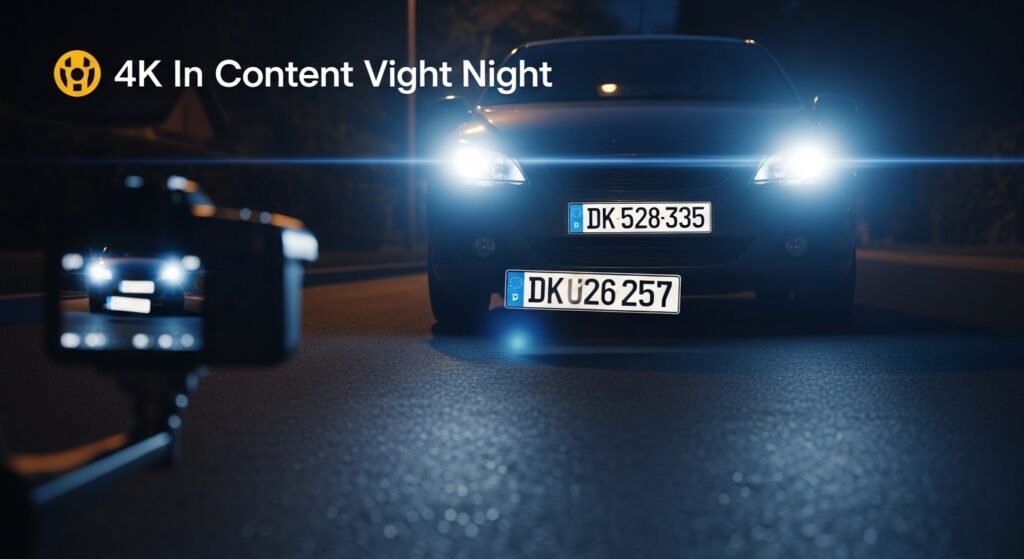
Clear imaging at night depends on three things: strong, even lighting; good contrast across bright and dark areas; and a lens that gathers enough light. Each part must work together to capture sharp, readable plate characters from varying distances and speeds.
Infrared (IR) Illumination
Infrared (IR) provides invisible light to the camera so plates stay visible without headlights. Cameras with built-in IR arrays or external IR illuminators help maintain consistent exposure on plates up to specific ranges (for example, 30–100 feet depending on model). IR works best on reflective plate material; non-reflective or dirt-covered plates may still be unreadable.
Use an IR setup with adjustable beam angle and power to avoid overexposure or hot spots. Pair IR with a narrow field of view lens to concentrate illumination on the lane or driveway. Many LPR cameras offer synchronized IR that pulses with the shutter to freeze motion and reduce blur.
| IR Feature | Why It Matters | Typical Range |
|---|---|---|
| Built-in IR LEDs | Compact, cost-effective night lighting | 20–50 ft |
| External IR Illuminator | Stronger, wider coverage for longer ranges | 50–150+ ft |
| Synchronized IR | Reduces motion blur by timing flashes | Depends on camera shutter |
High Dynamic Range (HDR)
High Dynamic Range (HDR) balances bright headlights and dim surroundings so plate characters remain legible. Without HDR, cameras can either blow out headlights or lose plate detail in shadows. HDR captures multiple exposures and blends them to keep specular highlights and shadow detail readable.
Look for cameras that list true multi-exposure HDR and have at least 100 dB dynamic range for LPR tasks. HDR helps most at driveways, tolls, or roads with oncoming traffic and mixed lighting. It does not replace good lighting, but it reduces glare and preserves contrast between alphanumeric characters and the plate background.
Wide Aperture Lenses
A wide aperture lens (low f-number like f/1.4–f/2.8) gathers more light, improving clarity at fast shutter speeds. That reduces motion blur for vehicles moving 20–70 mph, which is crucial when trying to read small letters and numbers from a distance. Wider apertures also allow lower ISO settings, which cuts noise and keeps edges sharp.
Match aperture with focal length and sensor size: a longer focal length narrows field of view but can reach farther. Many LPR installations use 6–12 mm lenses with f/1.6–f/2.0 for lanes and entrances. Consider motorized zoom or varifocal lenses to fine-tune framing and focus after installation.
Camera Types Best Suited for Plate Recognition
The right camera combines high resolution, strong low-light performance, and the correct lens. Lens type, sensor size, and onboard processing determine how clearly plates are captured at night.
ANPR/LPR Cameras
ANPR (Automatic Number Plate Recognition) or LPR cameras are made for reading plates. They use high-resolution sensors (usually 2–4 MP or higher) and specialized firmware that isolates plate regions and applies OCR. Many include infrared (IR) illumination tuned to reflect off plate surfaces without blinding drivers.
They also offer fast shutter speeds and high frame rates to freeze moving vehicles. Onboard analytics reduce false reads by filtering motion, angle, and blur. For night work, look for models with good low-light tech (e.g., DarkFighter or similar), adjustable IR power, and clear specifications for maximum recognition distance.
Key specs to check:
- Resolution and sensor size
- IR range and wavelength
- Frame rate and shutter speed
- Built-in LPR processing or edge AI support
Dome Versus Bullet Designs
Dome and bullet cameras differ mainly in mounting, field of view, and weather resistance. Bullet cameras often use longer varifocal or motorized zoom lenses (8–32mm or similar), which help focus on plates at distance. They are easier to aim at specific lanes or entrances.
Dome cameras blend into ceilings and soffits; they work well for overhead or angled views where short-to-medium range plate capture is needed. Vandal-resistant domes offer protection but may slightly reduce IR effectiveness if the dome cover reflects IR light.
Choose based on placement:
- Bullet: long-range, directional mounting, easy aim
- Dome: discreet, overhead coverage, vandal-resistant
Also confirm lens type, mounting height, and IP/IK ratings to match the installation and night-time lighting conditions.
Importance of Camera Placement and Angle
Placement and angle determine whether a camera gets a clear, readable plate at night. Small changes in height, distance, or tilt can make the difference between a sharp image and a blurred, unreadable plate.
Optimal Height and Distance
The camera should sit where plates fill the frame without distortion. Mounting height commonly falls between 3 and 10 feet (about 1 to 3 meters) depending on road grade and vehicle types. For most passenger cars, placing the lens around 3–6 feet gives a natural, near-level view of the plate.
Distance matters for resolution. Too close creates extreme angles; too far reduces pixel density on the plate. Aim for the plate to occupy at least 150–250 pixels across in a 1080p capture for reliable reading. Adjust lens zoom so the plate area fills about one-quarter to one-third of the frame width.
Use this quick reference for common setups:
| Situation | Height | Distance to Plate | Notes |
|---|---|---|---|
| Residential driveway | 3–5 ft | 5–15 ft | Lower height for passenger cars; watch for bushes |
| Entry lane / gate | 4–8 ft | 10–30 ft | Longer distance needs higher resolution or zoom |
| Roadside / highway | 6–10 ft | 15–50 ft | Use telephoto lens and higher frame rate |
Camera Alignment Strategies
Keep the plate angle close to perpendicular to the lens. Horizontal and vertical offsets should stay below about 15 degrees to reduce character distortion and reflection problems. When a vehicle approaches at an angle, place cameras to view the front or rear head-on rather than from a steep side angle.
Tilt the camera to avoid glare from headlights or streetlights. Slight downward tilt often helps at night by reducing direct reflections. Use manual focus and lock settings at night after dark, since autofocus can hunt under low light and blur frames.
For lanes, use staggered mounting: one camera aimed slightly left and another slightly right. That increases chances of a clear plate if one view is blocked by vehicle shape or obstructions. Mark fields of view on the ground during setup and test with cars at typical speeds to confirm readable captures.
Effects of Vehicle Speed on Plate Readability
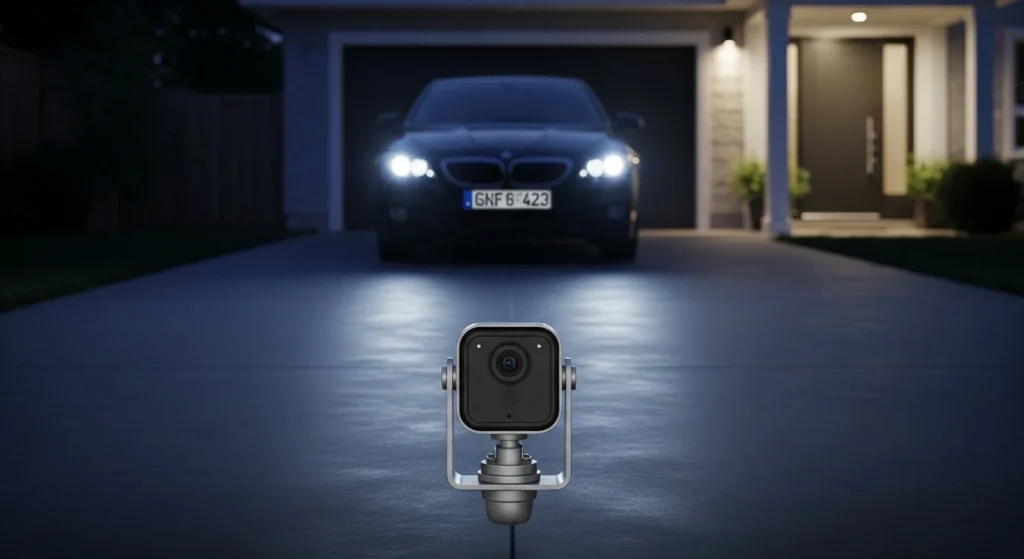
Higher vehicle speed increases the chance of blurred or partial plate images. Proper cameras and settings can reduce blur and keep characters sharp at typical road speeds.
Motion Blur Solutions
They can reduce motion blur by using higher frame rates and specialized LPR cameras that capture more frames per second. A camera running at 60+ fps catches more crisp frames of fast-moving plates than one at 15–30 fps.
Infrared or LED illumination synchronized to the camera can act like a short flash. This freezes the plate in one bright frame without overexposing surrounding areas.
Mounting matters. Placing cameras closer to the road and angling them to face oncoming traffic shortens the effective distance the plate moves across each frame.
Image stabilization and de-warping software can also improve readability by compensating for small shakes and lens distortion.
Shutter Speed Selection
Faster shutter speeds cut motion blur but reduce light per frame, so they work best with strong illumination. For night use, shutter speeds around 1/500 to 1/2000 second are common when paired with IR or active light sources.
If using slower shutters to save light, cameras should increase gain carefully; too much gain adds noise and hides plate characters.
They should balance shutter speed with aperture and illumination. Wider apertures (low f-number) and focused IR beams let the camera use shorter exposures while keeping the plate bright and legible.
Testing with real vehicle speeds and the chosen mount position gives the best shutter choice for consistently readable plates.
Role of Software and Image Processing
Software cleans up night images and turns them into readable plate text. It removes noise, boosts contrast, and then reads characters using trained models and rules.
Noise Reduction Techniques
Night footage often has grain, motion blur, and glare. Software uses temporal denoising to compare several frames and keep steady details while removing random noise. This helps when a car is moving slowly or when a camera captures multiple frames per second.
Spatial filters like Gaussian or bilateral filters smooth pixel noise but keep edges. Edge preservation is important because plate characters are high-contrast edges. Adaptive histogram equalization or contrast-limited methods improve local contrast on the plate area, making characters stand out without blowing out headlights.
Glare and bloom from headlights get handled by localized thresholding and morphological operations. The software may mask bright regions, then reconstruct plate pixels from surrounding data. Many systems let operators tune settings (denoising strength, frame buffer length, contrast limits) for their site conditions.
Plate Recognition Algorithms
After cleaning, the system locates the plate, segments characters, and reads them. Object detectors (YOLO, SSD variants) or classical contour analysis find the plate rectangle in the image. Detection outputs a cropped plate image for recognition.
Character segmentation splits the plate into character regions using vertical projection or connected-component analysis. For recognition, modern systems use convolutional neural networks (CNNs) trained on plate fonts and variations. These networks output character probabilities and handle font, size, and partial occlusion.
Systems often include post-processing checks: country/state pattern matching, checksum validation, and whitelist/blacklist lookups. A small table compares common recognition stages:
| Stage | Primary Methods | Purpose |
|---|---|---|
| Detection | YOLO-style CNN, contour detection | Find plate area in frame |
| Preprocessing | Denoising, contrast enhancement | Improve character visibility |
| Segmentation | Projection profiles, connected components | Separate individual characters |
| Recognition | CNNs, OCR engines | Convert images to text |
| Verification | Pattern checks, databases | Reduce false reads |
Legal and Ethical Considerations
Security cameras that read license plates at night raise questions about who can collect plate data, how long it can be kept, and what it can be used for. Laws vary by place, and organizations must balance safety with clear limits on surveillance.
Privacy Laws
Many states and cities regulate who may collect license plate data and how it may be used. Law enforcement agencies often have broader powers, but they still face rules on searches and tracking. For example, some jurisdictions require a warrant to use plate data to track a person’s movements over time.
Private companies and individuals face stricter limits in some areas. Municipal rules may ban private ALPR (automated license plate reader) networks or require consent and disclosure signs. Courts have also weighed in when plate collection becomes prolonged location tracking, treating it differently than a single public sighting.
Organizations should check state statutes and local ordinances before deploying night-capable cameras. They should also implement written policies that define who can query data, for what purposes, and when law enforcement access is allowed.
Data Storage Regulations
Data retention rules affect how long plate images and logs can be kept. Some states set strict maximum retention periods for non-criminal matches, often measured in days or months. Others require automatic deletion unless a specific investigation justifies longer storage.
Security practices matter. Entities should encrypt stored plate images, log access to records, and use role-based controls so only authorized staff can view sensitive data. Vendors should document data deletion processes and allow audits.
Transparency helps reduce legal risk. Posting clear notices about ALPR use, keeping minimal retention schedules, and regularly purging irrelevant records align with many regulatory frameworks and court expectations.
Installation Tips for Optimal Nighttime Use
Place the camera at a straight-on angle to the license plate whenever possible. A head-on view reduces distortion and makes characters easier to read. Aim for 20–40 feet (6–12 meters) from the expected stopping or passing point.
Use a camera designed for low-light or LPR (license plate recognition). These models often have IR illumination, higher frame rates, and adjustable shutter speeds. They can handle headlights and quick motion better than standard cameras.
Control lighting to avoid glare and blown highlights. If bright headlights hit the lens, add hooding or position the camera to the side slightly. Consider small, shielded IR or white-light illuminators to fill shadows without creating hotspots.
Fine-tune exposure, shutter speed, and gain in the camera settings. A faster shutter reduces blur but needs more light. Try starting with a shutter around 1/1000–1/2000 for moving cars and adjust as needed.
Test at night under real conditions and record samples for review. They should check captures across different weather and vehicle speeds. Repeat adjustments until plate characters are consistently legible.
Keep the lens clean and protected from condensation. Wipers, heaters, or hydrophobic coatings help in wet climates. Regular checks prevent dirt or fog from ruining otherwise good setup.
For general background on optical factors and night imaging, see imaging basics. For practical camera placement advice, readers may find industry placement guides helpful.
Common Issues and Troubleshooting Steps
Nighttime glare and overexposure often make plates appear bright white. They should try switching off IR mode or reducing IR power. Adding a controlled white light source can help without washing out the plate.
Retro-reflective plates and bright headlights bounce light back to the camera and hide characters. They can adjust the camera angle so light reflects away from the lens. Moving or shielding bright lights can also reduce reflection.
Low resolution or wrong focus will blur small plate characters. They should use a higher-resolution camera and set a narrow field of view aimed at the plate zone. Manual focus and test captures at night improve results.
Poor placement or distance causes small, unreadable plates. They should position the camera closer or add a zoom lens. Mounting the camera where vehicles slow or stop gives clearer frames.
Network or software issues may drop frames or break LPR processing. They should restart the camera and check firmware updates. Verifying connection and LPR settings in the camera’s web UI often fixes recognition problems.
Quick troubleshooting checklist:
- Check IR vs. white light (turn IR off briefly)
- Adjust angle to avoid retro-reflection
- Use higher resolution / zoom for small text
- Add controlled lighting (not direct glare)
- Restart and update firmware before deeper changes
If problems persist, testing with sample nighttime recordings helps isolate hardware from configuration issues.
Maintaining Camera Effectiveness Over Time
Cameras need regular care to keep reading plates clearly at night. Dust, insects, and water spots can blur images and reduce the chance of a correct read.
They should check lenses monthly and wipe them with a soft, lint-free cloth. Use a mild cleaner for stubborn grime, and avoid abrasive materials that scratch the lens.
Firmware and software updates matter. Updates can fix bugs, improve night-vision processing, and keep LPR/ANPR features accurate against new plate styles.
Seasonal checks help too. Trees, new construction, or changed streetlights can alter sightlines and glare. Repositioning or adjusting angle can restore clear views.
A short maintenance checklist helps teams stay consistent:
- Inspect lens and housing (monthly)
- Test IR/illuminators at night (quarterly)
- Update firmware and analytics (as released)
- Verify camera alignment after storms or work (after events)
Record keeping improves long-term performance. They should log inspections, adjustments, and firmware versions. Logs make it easier to spot recurring problems and plan replacements.
When a camera ages, image quality can drop even with good care. If daily maintenance and updates don’t fix issues, replacement with a newer LPR-capable model may be the best choice.
FAQS
What affects a camera’s ability to read plates at night?
They need good resolution, proper lens, and night lighting. Infrared or full-color low-light tech helps. Distance and angle also matter.
Can regular home security cameras read plates?
Usually no. Most consumer 1080p cameras struggle at distance or in the dark. Dedicated LPR/ANPR cameras are built for plate capture.
Is infrared (IR) better than color night vision?
IR works well for clear, high-contrast plate images but shows monochrome pictures. Color night vision can help when surrounding light is present, making characters easier to read.
How close must the car be?
Closer is better. Many LPR systems specify an optimal range, often 5–30 feet depending on lens and resolution. Too far or a steep angle lowers accuracy.
Will motion blur ruin plate reading?
Yes. Fast-moving vehicles can blur characters. Higher frame rates and shorter exposure times reduce blur and improve recognition.
Can software help read plates at night?
Yes. License plate recognition software improves accuracy by enhancing contrast and matching characters. It cannot fully fix poor image quality, though.
Are there legal or privacy issues?
Laws vary by place. They should check local rules on recording license plates and storing data. Public safety uses often differ from private surveillance.
Conclusion
Security cameras can read license plates at night when they have the right equipment and setup. High resolution, good low-light performance, and proper placement all play a role.
Infrared illumination or dedicated LPR (license plate recognition) cameras improve results. Distance, angle, and motion still affect clarity, so positioning matters.
Choosing a camera with clear specs helps. Look for resolution, frame rate, and night-vision type before buying.
Installation choices matter as much as the camera. Mounting height, angle, and lighting will change how often plates are captured accurately.
Maintenance and testing keep performance steady. Regularly clean lenses, check focus, and review sample footage at night.
Costs rise with capability, but modest upgrades can make a big difference. For critical needs, professionals can recommend systems tuned for plate reading.
Users should balance privacy and local laws when using plate-capture systems. Responsible use and clear signage help avoid legal issues.
If reliable night capture is important, invest in suitable hardware and proper setup. That gives the best chance of reading plates consistently in low light.