Most home security camera systems need anywhere from 64GB to several terabytes of storage, depending mainly on the number of cameras, video bitrate, resolution, recording schedule, and how many days of footage you want to keep.
For a typical U.S. home, the right amount of security camera storage depends less on the camera’s resolution alone and more on how much video data the system records. A single 1080p camera recording motion events may use relatively little storage, while several 4K cameras recording continuously can consume hundreds of gigabytes in only a few days.
If you are installing cameras around a house in the United States, start by deciding how long you want recordings available. Seven days may be enough for a low-traffic home using motion recording, while 14 to 30 days may make more sense when you want a longer history or use continuous recording. For larger properties, businesses, or systems with many cameras, storage requirements can quickly reach several terabytes.
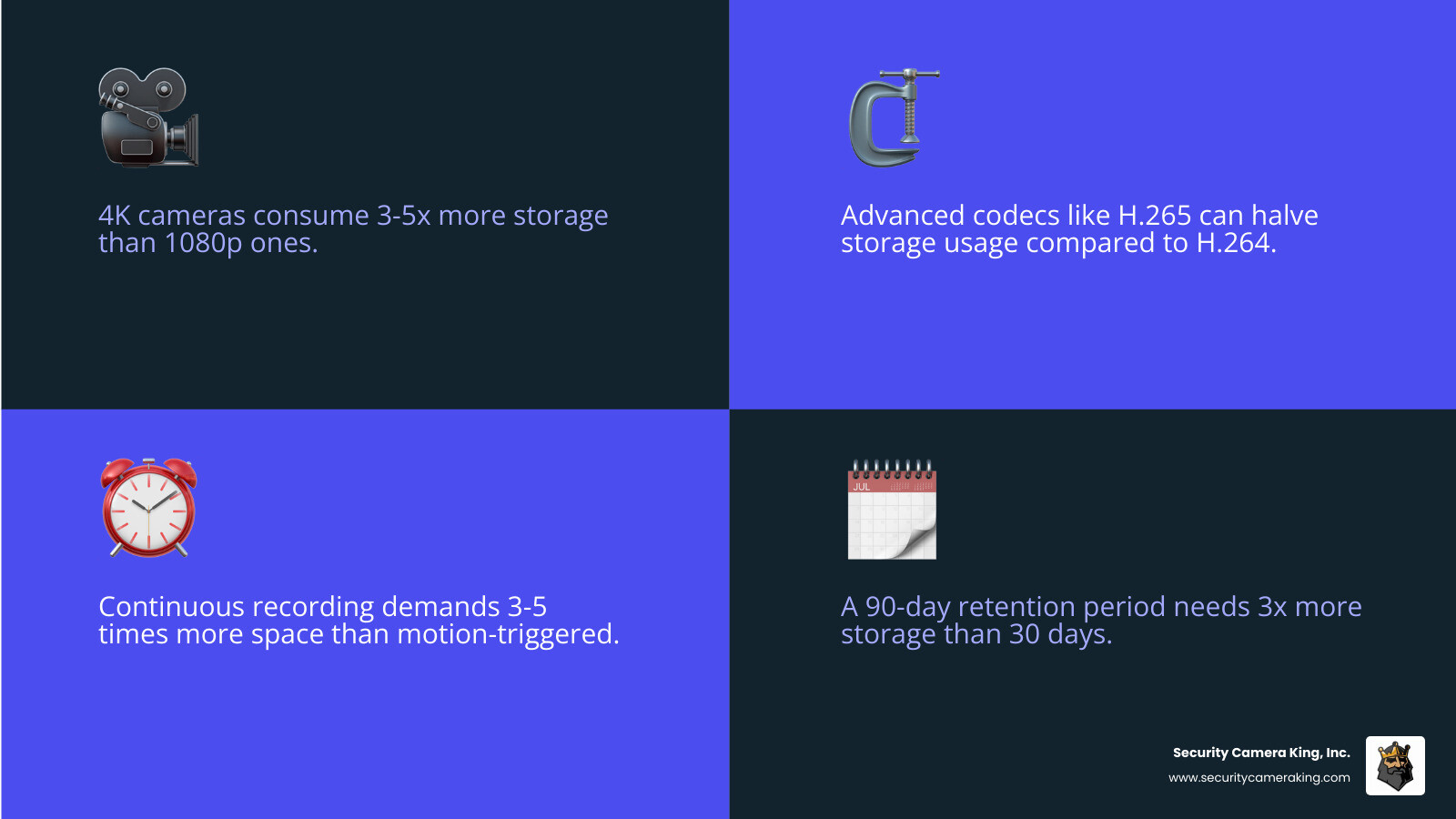
Source: securitycameraking.com
What Determines How Much Security Camera Storage You Need?
The amount of storage a security camera needs is determined by the amount of video data it produces and how long you want to retain that data. A camera recording at a high bitrate creates larger files than the same camera recording at a lower bitrate, even when the resolution is unchanged.
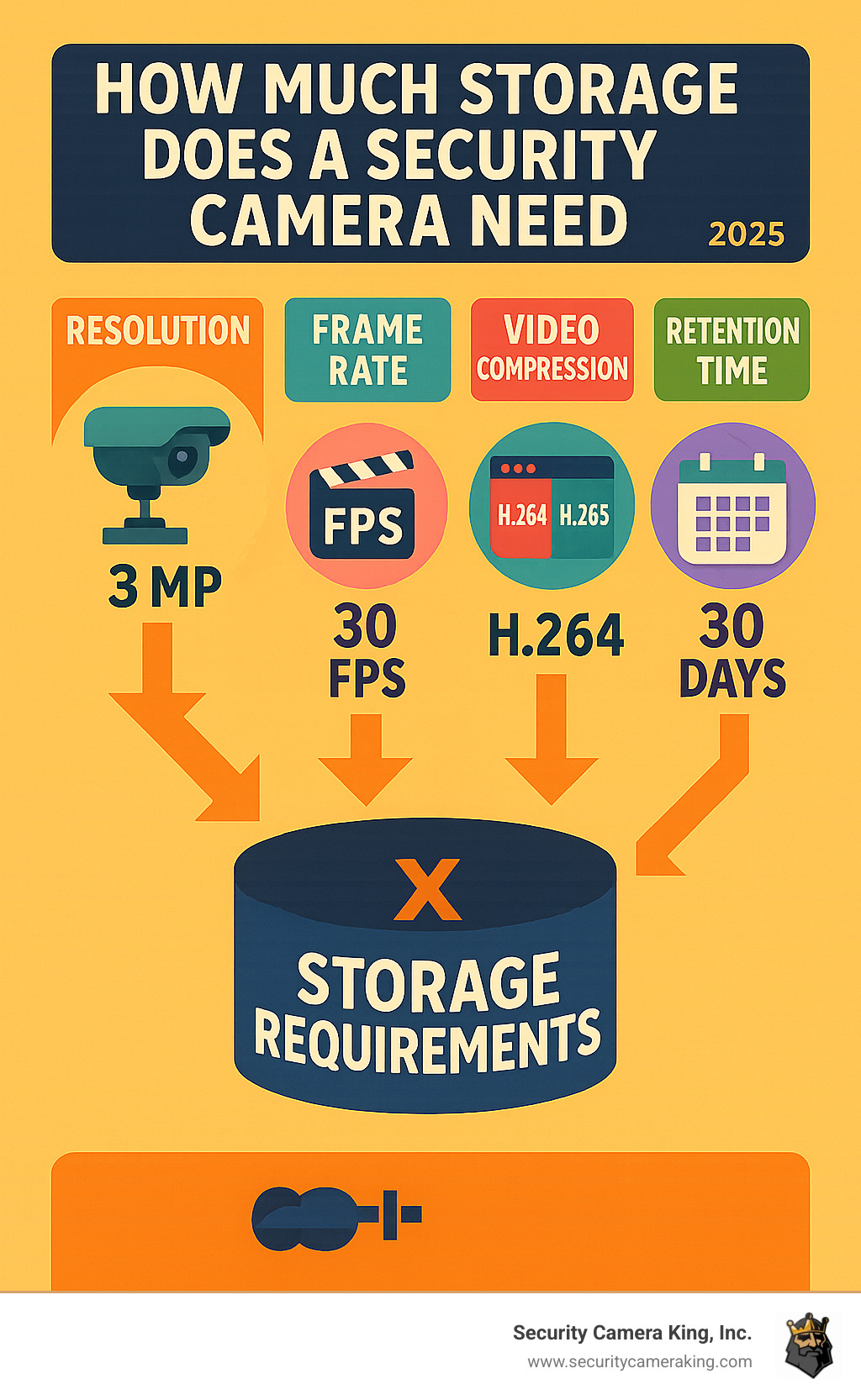
The most important variables are the number of cameras, bitrate, recording hours per day, retention period, frame rate, resolution, compression method, and whether the camera records continuously or only when motion is detected.
Resolution is useful when comparing image detail, but it should not be used by itself to estimate storage. Two cameras with the same 4K resolution can use different amounts of storage if their bitrate, frame rate, compression, or recording settings differ.
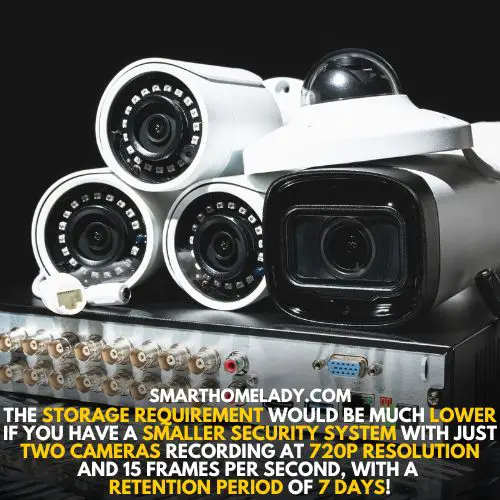
Source: smarthomelady.com
Number of cameras
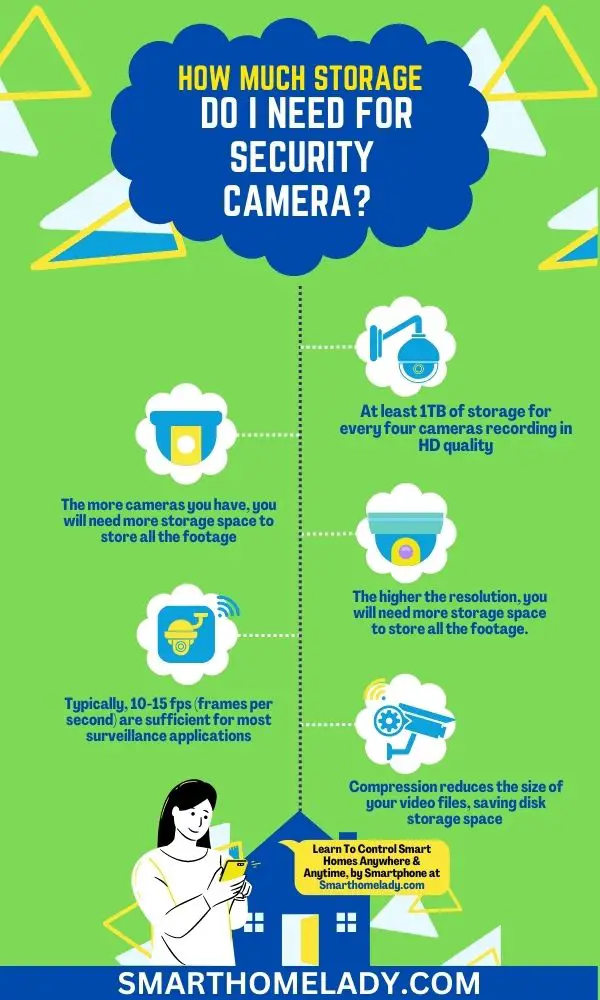
Every camera adds its own video stream to the storage requirement. Four cameras generally use about four times the storage of one camera when their recording settings are otherwise the same.
Bitrate
Bitrate measures how much video data is generated each second. A higher bitrate normally means larger recordings and faster storage consumption.
Recording schedule
A camera recording 24 hours per day creates much more data than one recording only when motion or another event occurs.
Retention period
Keeping footage for 30 days requires roughly twice as much storage as keeping the same footage for 15 days, assuming the recording settings remain unchanged.
Compression
Modern video codecs can reduce the amount of storage required compared with less efficient compression, but the exact savings depend on the camera and its settings.
Resolution and frame rate
Higher-resolution video generally contains more visual information and can require more storage, but resolution alone does not determine the file size. Bitrate is usually the more useful value when calculating storage because it directly represents the amount of data being recorded.
Frame rate also affects storage. Recording at a higher number of frames per second can generate more data than recording the same scene at a lower frame rate, although the actual difference depends on the camera’s encoding system and bitrate settings.
1080p
Often suitable for general home monitoring and can require less storage than higher-resolution formats when comparable settings are used.
2K
Provides more image detail than 1080p and may require additional storage depending on bitrate and frame rate.
4K
Can provide substantially more detail for areas such as driveways and entrances, but continuous high-bitrate recording can consume storage quickly.
How Much Storage Does a Security Camera Use Per Day?
A useful way to estimate daily storage is to start with the camera’s bitrate. For continuous recording, storage consumption increases directly with bitrate and the number of hours recorded.
As a practical calculation, a camera recording at 1,000 Kbps continuously produces about 10.8 GB of video data per day before accounting for system-specific overhead and differences in how capacity is measured. At 4,000 Kbps, the same calculation produces about 43.2 GB per camera per day.
These figures are mathematical estimates rather than universal recording capacities. Actual storage use can differ because cameras may use variable bitrate, multiple streams, audio, different encoding settings, or other recording features.
Source: storage.googleapis.com
1,000 Kbps
Approximately 10.8 GB per day for one camera recording continuously.
2,000 Kbps
Approximately 21.6 GB per day for one camera recording continuously.
4,000 Kbps
Approximately 43.2 GB per day for one camera recording continuously.
8,000 Kbps
Approximately 86.4 GB per day for one camera recording continuously.
Why bitrate is more useful than resolution for storage calculations
When a camera manufacturer specifies a maximum or selected bitrate, that value gives you a much better starting point for estimating storage than simply knowing that the camera is 1080p, 2K, or 4K.
For example, two 4K cameras can have very different storage requirements if one records at a substantially higher bitrate. This is why surveillance storage calculators commonly ask for bitrate, resolution, frame rate, compression, recording hours, number of cameras, and retention days.
Check the camera settings
Look for maximum bitrate, target bitrate, or recording bitrate in the camera app, web interface, or product documentation.
Check the recorder settings
An NVR may apply recording settings that differ from the camera’s default live-view settings.
How to Calculate Security Camera Storage
You can estimate storage for continuous recording with a simple bitrate-based formula. The calculation is especially useful for NVR and DVR systems with multiple cameras.
For a practical estimate in decimal gigabytes, use: Storage in GB = bitrate in Kbps × recording hours × 3600 × number of cameras × retention days ÷ 8,000,000.
If a system records only part of each day, use the actual recording hours rather than 24. If it records continuously, use 24 hours. For motion recording, the calculation needs an estimate of the actual recording time or event activity because the camera is not storing video continuously.
Use the recording bitrate in Kbps for each camera or camera group.
Step 2: Count the cameras
Multiply the data rate by the number of cameras using the same or comparable recording settings.
Step 3: Determine recording hours
Use 24 hours for continuous recording or a realistic daily recording estimate for scheduled or event-based recording.
Step 4: Choose retention
Decide how many days of footage you want available before older recordings are overwritten.
Step 5: Add capacity margin
Choose more capacity than the mathematical minimum to accommodate system overhead, changing settings, additional cameras, or higher activity.
Example: four cameras for 14 days
Consider a hypothetical four-camera system in which each camera records continuously at 4,096 Kbps. One camera would generate approximately 44.2 GB per day using the simple decimal calculation. Four cameras would therefore generate approximately 176.9 GB per day.
Over 14 days, the estimated requirement would be about 2,476 GB, or roughly 2.48 TB. In practice, choosing a drive with more capacity than this calculated minimum is sensible because usable capacity is affected by formatting, system behavior, and recording settings.
This example also shows why a seemingly large hard drive can fill faster than expected. A multi-camera system does not consume storage at the rate of one camera; the data streams accumulate simultaneously.
One camera
Approximately 44.2 GB per day at 4,096 Kbps continuous recording.
Four cameras
Approximately 176.9 GB per day at the same bitrate.
Fourteen days
Approximately 2.48 TB of calculated video data before practical capacity considerations.
The reverse calculation: how long will my storage last?
If you already own an NVR hard drive or memory card, you can reverse the calculation to estimate how many days it may hold. Divide available storage by the estimated daily video consumption, while remembering that advertised capacity and usable recording capacity are not always identical.
This is often the most useful approach when upgrading an existing system. If your current drive holds about seven days and you want approximately 14 days with the same cameras and settings, you will generally need about twice the usable storage capacity.
More storage
Increasing the drive or card capacity extends retention when all other recording settings remain unchanged.
Lower bitrate
Reducing bitrate can extend retention but may reduce image detail or introduce more compression.
Less recording time
Reducing daily recording hours can extend retention without changing the camera’s image resolution.
How Much Storage Do Security Cameras Need for 7, 14, or 30 Days?
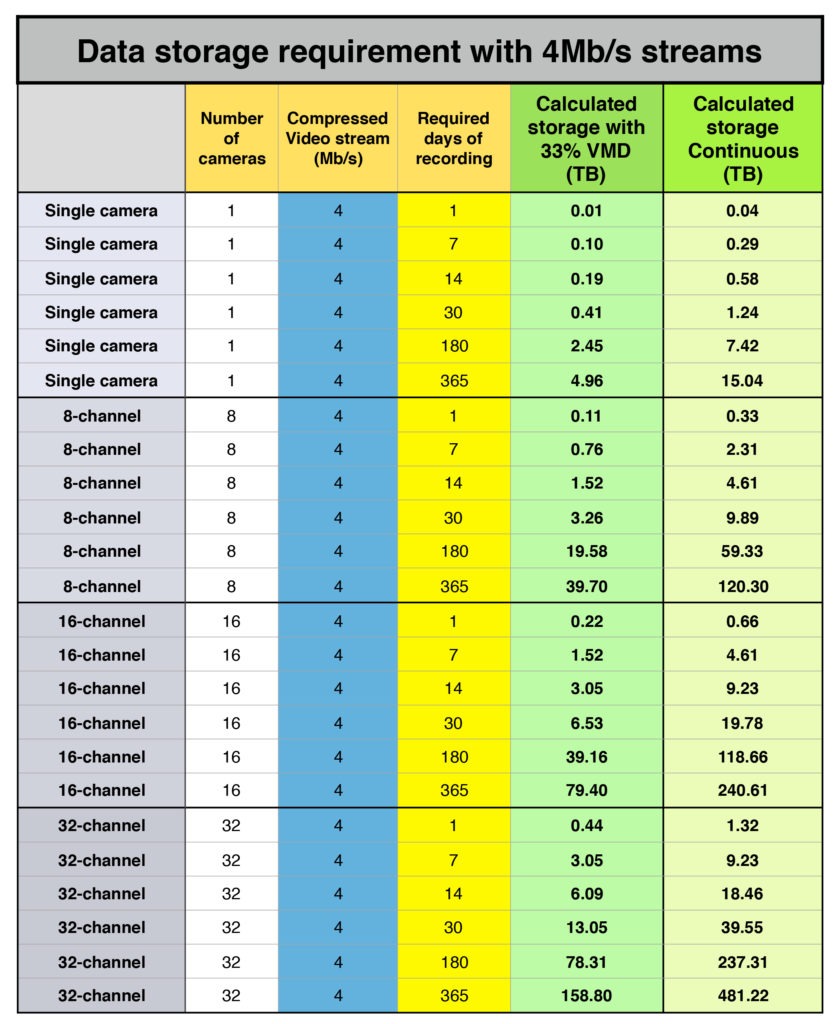
The answer depends on the total bitrate of the camera system. A useful way to think about retention is that doubling the desired number of recording days approximately doubles the required storage when the number of cameras, bitrate, and recording schedule stay the same.
For a single camera, relatively modest storage may be sufficient for short retention when recording is motion-triggered. For several cameras recording continuously, a hard drive measured in terabytes is often more appropriate.
The following examples are hypothetical calculations based on a continuous bitrate of 4,000 Kbps per camera. They are intended to show how storage scales and should not be treated as a universal requirement for every camera model.
Source: securitycameraking.com
One camera for 7 days
About 302 GB of calculated storage at 4,000 Kbps continuous recording.
One camera for 14 days
About 605 GB of calculated storage at 4,000 Kbps continuous recording.
One camera for 30 days
About 1.30 TB of calculated storage at 4,000 Kbps continuous recording.
Four cameras for 30 days
About 5.18 TB of calculated storage at 4,000 Kbps per camera with continuous recording.
Why your actual storage requirement may be lower
Motion-triggered recording can dramatically reduce the amount of video written to storage because the camera records only during selected events. The exact reduction cannot be predicted reliably without knowing how much motion occurs in the camera’s view and how the detection system is configured.
A quiet backyard and a busy driveway can produce very different storage consumption even when both cameras have identical specifications. Motion zones, person and vehicle detection, schedules, and event sensitivity can therefore have a major practical effect on retention.
Low-traffic area
May generate relatively few event clips and therefore use considerably less storage than continuous recording.
Busy driveway
Can generate frequent events, particularly when vehicles, pedestrians, animals, or weather changes trigger recording.
24/7 critical coverage
Requires substantially more storage because the entire timeline is recorded rather than selected events.
How Much Storage Does a 1080p, 2K, or 4K Camera Need?
There is no universal storage number for 1080p, 2K, or 4K cameras because cameras with the same resolution can use different bitrates, frame rates, codecs, and recording settings. Still, resolution is useful as a starting point when comparing systems.
A 1080p camera commonly requires less storage than a 2K or 4K camera when all other recording variables are comparable. However, a carefully configured high-resolution camera can sometimes use less storage than another camera with a lower resolution but a substantially higher bitrate.
For that reason, use the manufacturer’s stated recording bitrate whenever it is available. If the camera does not provide a bitrate figure, use the manufacturer’s storage calculator or recording estimates rather than assuming a fixed number of gigabytes per resolution.
Source: betternestlab.com
1080p security cameras
Often suitable for general residential monitoring and may have relatively modest storage needs, particularly with motion recording.
2K security cameras
Provide more image detail and generally require more data than 1080p when comparable settings are used.
4K security cameras
Can provide useful detail for identifying activity at important locations but can consume substantial storage during continuous high-bitrate recording.
Do higher megapixels always mean more storage?
Not necessarily. Higher resolution increases the amount of visual information available, but the storage impact is controlled by the encoded bitrate and other recording settings. A camera can be configured to compress video more aggressively or use a lower bitrate, changing its storage requirements.
The practical trade-off is straightforward: lowering bitrate can save storage, but excessive compression can reduce useful detail. If a camera covers a front door, license-plate area, or other location where fine details matter, avoid reducing recording quality solely to save storage without checking the resulting image.
Storage priority
Use bitrate and recording hours as the primary calculation inputs.
Evidence priority
Keep sufficient image quality for the identification task the camera is intended to support.
How Much SD Card Storage Does a Security Camera Need?
For a single camera with a microSD card slot, 64GB, 128GB, 256GB, or larger cards can be useful depending on the camera’s supported capacity and recording mode. Continuous recording consumes space much faster than motion recording.
As a practical starting point, 64GB may be reasonable for shorter or event-based recording on a lower-bitrate camera, while 128GB to 256GB provides more flexibility. A 4K camera recording continuously may benefit from a substantially larger supported card, but the exact requirement should be calculated from its bitrate and the manufacturer’s storage limits.
Do not assume that every camera accepts every SD card capacity. The camera’s documentation determines the maximum supported capacity and may also specify card type, speed, endurance, or formatting requirements.
Source: smarthomelady.com
64GB
Can be suitable for shorter retention or motion-based recording when the camera’s bitrate is relatively low.
128GB
Provides a useful middle ground for many single-camera installations, especially when recording is not continuous.
256GB
Offers substantially more capacity for higher-resolution cameras or longer retention, subject to camera compatibility.
512GB or larger
Can be useful for compatible cameras with high-bitrate or extended recording requirements, but support varies by model.
Check endurance before buying a card
Security cameras can write data repeatedly, especially when they record continuously. A card designed for frequent video recording is generally more appropriate than choosing solely on advertised capacity. The camera manufacturer’s compatibility guidance should take priority.
If important footage is stored on a microSD card, regularly verify that recordings can actually be played back. A large capacity does not guarantee reliable recording, and a storage device that is full, incompatible, or failing can undermine the purpose of the camera.
Compatibility
Confirm the camera supports the card capacity and card type before purchasing.
Recording endurance
Choose media intended for repeated video recording when the camera writes frequently.
Playback testing
Periodically confirm that saved footage can be opened and exported successfully.
How Much NVR Storage Do You Need for Multiple Cameras?
For systems with several wired or Wi-Fi cameras, an NVR with a surveillance hard drive is often more practical than relying on separate memory cards. The required hard-drive capacity depends on the combined bitrate of all cameras and the desired retention period.
A simple way to estimate an NVR requirement is to add the recording bitrates of all cameras, then calculate the storage needed for the desired number of hours and days. If four cameras each record at 4,000 Kbps, the combined bitrate is 16,000 Kbps.
A four-camera system at that combined rate would generate approximately 172.8 GB of video data per day under continuous recording. Over 14 days, the mathematical estimate is approximately 2.42 TB before practical overhead and capacity considerations.
Source: thehomereviews.com
2-camera system
A modest NVR drive may be enough for short retention, but continuous high-bitrate recording can still consume hundreds of gigabytes quickly.
4-camera system
A multi-terabyte drive becomes more useful when continuous recording is required for one to several weeks.
8-camera system
Storage requirements can grow rapidly because eight simultaneous video streams are being recorded.
16-camera system
A careful storage calculation becomes essential, especially for continuous high-resolution recording and longer retention.
Choose surveillance-rated storage for continuous recording
An NVR that records around the clock places sustained write activity on its hard drive. For this type of workload, use a drive intended and specified for surveillance recording rather than choosing a consumer drive based only on capacity.
Also check the NVR’s supported drive capacity, number of drive bays, recording throughput, and camera-channel limits. A large hard drive is not useful if the recorder cannot support it.
Drive capacity
Determines how much recorded footage can be retained before older footage is overwritten.
Drive compatibility
The NVR manufacturer may specify supported drive sizes and formats.
Recorder limits
The NVR must be capable of handling the total number of cameras and their combined recording bitrate.
Cloud Storage vs. Local Storage for Security Cameras
Cloud storage and local storage solve the same basic problem in different ways. Local storage saves recordings on a microSD card, NVR, DVR, home hub, or other device at the property, while cloud storage sends recordings to remote servers managed by a service provider.
Local storage gives you direct control over physical storage capacity and usually does not require a recurring cloud storage fee, but you are responsible for the storage hardware and its failure risk. Cloud storage can make off-site access and retention management easier, but available retention and features depend on the provider’s current plan and service terms.
For an important security system, consider what happens if the camera or recorder is stolen, damaged, or inaccessible. Local-only storage may be vulnerable to an event affecting the physical property. Cloud storage can provide an off-site copy, but it introduces dependence on the provider, network connection, account access, and subscription terms.
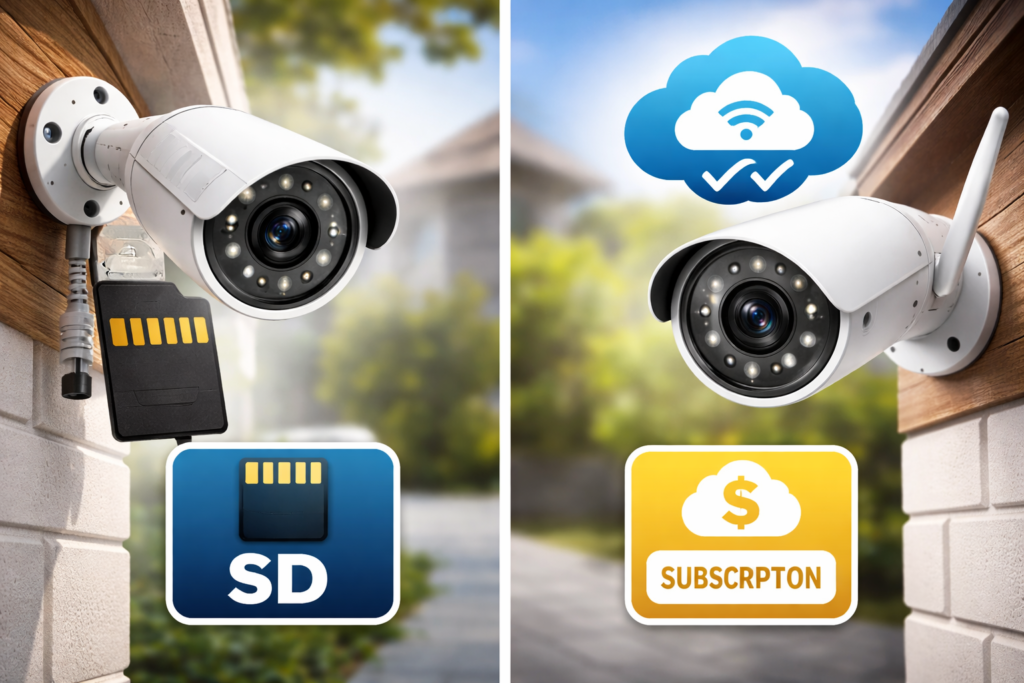
Source: securitycameraking.com
Local microSD storage
Simple for individual cameras but capacity is limited and the card remains at the camera location.
NVR or DVR storage
Useful for multi-camera systems and longer continuous recording, with capacity determined by installed drives.
Cloud storage
Useful for remote access and off-site retention, but storage duration and features vary by provider and subscription.
Hybrid storage
Some systems can combine local recording with cloud or remote backup, providing additional resilience when supported.
How long should you keep security camera footage?
There is no universal retention period for every U.S. home. A homeowner should choose a period based on the purpose of the cameras, how quickly incidents are normally discovered, available storage, and any applicable organizational or legal requirements.
For ordinary residential monitoring, seven to 14 days can be a reasonable planning target for many systems, while 30 days may be preferable when you want a larger window to review an incident. Businesses, rental properties, and other environments may have different operational, contractual, or legal requirements that should be considered separately.
Short retention
Useful when cameras mainly provide immediate awareness and events are likely to be reviewed quickly.
Two-week retention
Provides a longer review window without requiring as much capacity as a full month of continuous recording.
Thirty-day retention
Useful when incidents may not be discovered immediately, but it requires substantially more storage for continuous recording.
If your storage fills too quickly, you do not always need to buy a larger drive immediately. Adjusting the recording configuration can reduce data consumption, although each change involves trade-offs.
The safest approach is to make one change at a time and verify that the resulting footage still provides enough detail for the camera’s purpose. A storage-saving setting is not helpful if it makes important faces, vehicles, or other details too difficult to identify.
Source: www.youtube.com > Pipl Systems
Use motion recording when appropriate
Recording only events can substantially reduce storage use compared with continuous recording, particularly in low-traffic areas.
Use scheduled recording
Record during the periods when complete coverage is actually needed instead of recording continuously when there is little activity.
Reduce unnecessary bitrate
A lower bitrate can reduce storage consumption, but test the resulting image quality before making the change permanent.
Use efficient compression
If the camera and recorder support a more efficient codec, it may reduce storage requirements while maintaining comparable image quality.
Adjust frame rate carefully
Lowering frame rate can reduce data generation, but very low frame rates may make fast movement harder to review.
Create motion zones
Limiting detection to relevant areas can reduce unnecessary event recordings caused by streets, trees, sidewalks, or other background activity.
Export important footage
Save critical clips to separate storage before the camera system automatically overwrites older recordings.
Do not reduce storage at the expense of useful evidence
Storage optimization should always come after deciding what the camera needs to capture. A driveway camera intended to identify vehicles may need different settings from a backyard camera intended only to detect movement.
Before lowering resolution, bitrate, or frame rate, record a short test and review it on the device you will actually use. Check faces, vehicle details, nighttime scenes, moving subjects, and any other details that matter for the camera’s purpose.
Test daytime footage
Make sure important details remain clear under normal daylight conditions.
Test nighttime footage
Confirm that compression or lower bitrate has not made low-light footage unusably soft or noisy.
Test movement
Review moving people and vehicles to make sure the chosen frame rate and bitrate remain adequate.
Frequently Asked Questions
Q
Is 128GB enough for a security camera?
It can be enough for a single camera when recording is motion-triggered or when the camera uses a relatively low bitrate. It may not be enough for long-term 24/7 recording, particularly at high resolution. Check the camera’s bitrate and calculate the expected recording time before choosing the card.
Q
How much storage do I need for four security cameras?
There is no single answer because four cameras can have very different bitrates and recording schedules. As a hypothetical example, four cameras recording continuously at 4,000 Kbps each would generate approximately 172.8 GB per day. Fourteen days would therefore require about 2.42 TB of calculated video data before practical capacity considerations.
Q
Is 1TB enough for security cameras?
A 1TB drive can be enough for a small system or shorter retention period, especially with motion recording. For several cameras recording continuously, 1TB may provide only a relatively short recording window. Calculate the combined bitrate and desired retention period before deciding.
Q
How long will a 2TB hard drive record security cameras?
The answer depends on the total recording bitrate. A 2TB drive can retain very different amounts of footage from one camera versus eight cameras, and continuous recording consumes storage much faster than event-based recording. Use the combined bitrate of all cameras to calculate the expected retention period.
Q
Do security cameras overwrite old footage when storage is full?
Many security camera systems support loop or overwrite recording, in which older footage is automatically replaced when available storage becomes full. This behavior varies by camera and recorder, so check the recording settings before relying on the system to retain footage for a specific period.
Q
Does 4K security camera footage need more storage?
It often does when the 4K camera uses a higher bitrate, but resolution by itself does not determine storage consumption. Bitrate, frame rate, compression, recording hours, and the number of cameras all affect the final requirement.
Q
Can motion detection save security camera storage?
Yes. Motion-based recording can reduce storage consumption because the system records selected events instead of saving video continuously. The amount saved depends on how often motion occurs and how the detection system is configured.
✦ Wrapping Up
Conclusion
The amount of storage security cameras need depends primarily on how much video data the system creates and how long you want to keep it. Camera count, bitrate, recording schedule, retention period, frame rate, resolution, and compression all influence the result.
For a single residential camera, a 64GB or 128GB card may be sufficient for some shorter or motion-based recording setups, while larger cards can be useful for higher-bitrate or longer recordings. For several cameras recording continuously, an NVR with a multi-terabyte surveillance drive is often more practical.
The most reliable way to choose storage is to use the camera’s actual recording bitrate rather than relying on resolution alone. Calculate the combined bitrate of all cameras, multiply it by the number of recording hours and desired days, then select a storage capacity with reasonable headroom.
💡 Key Takeaway
Before buying an SD card or NVR hard drive, find the recording bitrate for each camera, decide whether you need continuous or motion recording, choose your desired retention period, and calculate the resulting storage requirement. Then select a compatible storage device with additional capacity rather than buying exactly at the mathematical minimum.
I’m Ethan Carter, a home security systems specialist at Diggons.com. I focus on modern surveillance solutions and smart protection technologies that help people keep their homes safe and secure.
I have hands-on experience working with security cameras, video doorbells, alarm systems, and motion detection devices. I test real products and explore practical setups so I can provide clear, easy-to-follow guidance for everyday users.
My goal is to simplify home security by helping you understand how these systems work, how to fix common issues, and how to choose the right products with confidence. At Diggons.com, I share honest insights, comparisons, and real-world advice to make home security easier and more effective.