
Quick answer: For most beginners, buying your core DIY home security devices from one company is easier and usually gives you better compatibility. But you do not have to buy everything from one brand. Mixing brands can be the better choice when one company does not offer the camera, lock, storage, privacy features, or price you actually need.
I’m James Walker, and I focus on practical home security advice for Diggons.com. One of the easiest mistakes to make is buying a camera, alarm, doorbell, and smart lock separately without checking how well they work together. The result can be several apps, separate subscriptions, and devices that do not cooperate properly.
In this guide, I’ll show you when one company makes sense, when mixing brands is smarter, and which parts of a DIY security system should ideally stay together.
Why Your Home Security Brand Choice Matters
A home security system is more than a collection of gadgets. Your alarm sensors, cameras, doorbell, locks, app, notifications, and monitoring service all need to work reliably when something happens.
Imagine someone opens a back door at 2 a.m. Ideally, the door sensor should trigger the alarm, your phone should receive an alert, and your cameras should give you useful video. If every device uses a different platform, getting that chain of events working can take more effort.
A single ecosystem can simplify that process because the manufacturer designs its products to work within the same account, app, and support environment.
That does not automatically make one company better. A closed ecosystem can also limit your choices and make it harder to replace one weak device with a better product from another manufacturer.
Before buying anything, I recommend deciding whether your priority is simplicity or flexibility.
How a Single Home Security Ecosystem Works
Security cameras and video doorbells
Cameras and doorbells are usually the most visible part of a DIY security setup. They provide live video, motion alerts, night vision, two-way audio, and recorded footage depending on the model and subscription.
When the camera and alarm system come from the same ecosystem, the app experience is often simpler. Instead of switching between several apps, you may be able to manage security events from one place.
Alarm hubs and entry sensors
The alarm hub or base station is the center of the intrusion-protection side of the system. Door and window sensors, motion sensors, and other security components communicate with it.
This is one area where I strongly prefer staying within the same ecosystem unless you know exactly how compatibility works. Alarm sensors are not as interchangeable as ordinary consumer electronics.
Smart locks and access control
Smart locks can be useful because they connect physical access to your security system. For example, you might want the system to lock the front door when you leave or show the lock status in the same security app.
But compatibility matters. A lock may technically work with your broader smart-home platform without offering every security function inside your alarm app.
One app and one account
This is one of the biggest reasons beginners prefer a single company. One app can make it easier to arm or disarm the alarm, review camera alerts, check a doorbell, and manage users.
Ring, for example, integrates its security products with Alexa, including functions such as viewing compatible cameras and controlling certain security modes. Ring’s official Alexa integration guide explains how its devices connect within that ecosystem.
Professional monitoring and cellular backup
Some homeowners want self-monitoring, while others want a professional monitoring center to respond to alarm events.
The distinction becomes particularly important during an internet outage. A system with cellular backup may still be able to send alarm signals even when your normal internet connection fails. Ring, for example, documents both alarm cellular backup and broader backup-internet features for compatible products and plans. Ring’s home security information explains the current backup options.
One Company vs Multiple Home Security Brands
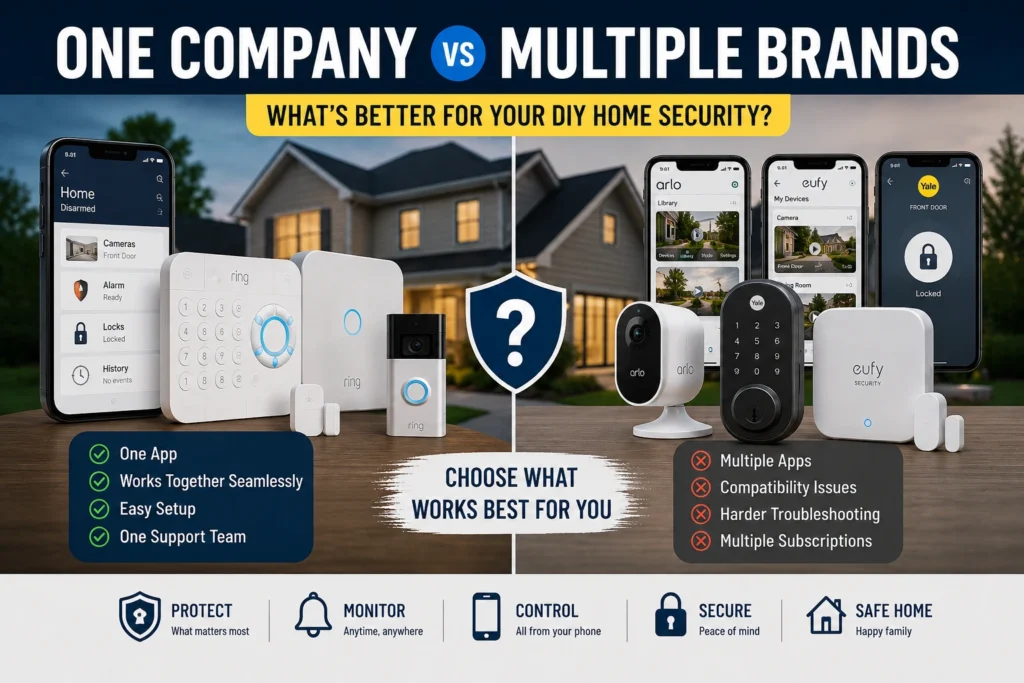
Advantages of buying one brand
Setup is usually easier. The same manufacturer normally provides the app, account system, manuals, and support process.
Compatibility is easier to verify. You are less likely to discover that a sensor or lock requires a separate hub or cannot perform an expected function.
You may get a cleaner user experience. One account and one main app can make daily security tasks less confusing.
Troubleshooting can be simpler. When a camera does not work correctly, you have one company responsible for the device and its software platform.
Expansion is easier. Once your base system is working, adding another sensor or camera from the same product family is often straightforward.
Advantages of mixing brands
You can choose the best device for each job. One company may have a better doorbell, while another may offer a better outdoor camera or local-storage option.
You have more flexibility. You are not forced to accept whatever camera, lock, or sensor a single manufacturer sells.
You can avoid some forms of vendor lock-in. If one product line disappoints you, you may be able to replace that component without rebuilding the entire system.
You can prioritize different requirements. For example, you might care more about camera image quality, local video storage, or privacy controls than having every device inside one application.
Single Ecosystem vs Mix-and-Match: Full Comparison
| Factor | One Company | Multiple Brands |
|---|---|---|
| Initial setup | Usually simpler | Usually more complicated |
| Device compatibility | Generally easier to verify | Must be checked carefully |
| Apps | Often one main app | May require several apps |
| Product choice | More limited | Much wider |
| Troubleshooting | Usually easier | Can be more difficult |
| Vendor lock-in | Higher | Usually lower |
| Best for | Beginners and simplicity | Experienced DIY users |
Which Home Security Devices Should Stay in One Ecosystem?
Alarm hub and sensors
This is the part I would be most careful about mixing. Door contacts, motion sensors, glass-break sensors, keypads, and the alarm hub are designed around specific communication protocols and software.
Rather than assuming two products will work together because they both use wireless communication, check the manufacturer’s compatibility list before buying.
Security cameras and doorbells
Cameras are easier to mix in some setups, but you can lose convenience. Separate camera brands may mean different apps, different notification systems, different cloud plans, and different recording rules.
That can still be worthwhile when one camera is clearly better suited to your property.
Smart locks
Locks deserve special attention because reliability matters more than novelty. A lock that looks great in the app is not useful if it becomes unresponsive, loses battery power quickly, or fails to integrate correctly with your alarm routines.
Monitoring service
Professional monitoring is usually tied closely to the alarm platform. This is another area where keeping your core alarm equipment together often makes sense.
For example, SimpliSafe’s current residential monitoring plans cover alarm events such as intrusion, smoke, CO, and certain environmental alerts, with plan-specific features. Its official support documentation also states that the plans are month-to-month rather than contract-based. SimpliSafe monitoring plan information has the current details.
When Buying Everything From One Company Makes More Sense
I would lean toward a single ecosystem if you are buying your first full home security system and want the least complicated setup.
This is especially useful for apartments, rental homes, family homes, and anyone who does not want to spend weekends solving compatibility problems.
It also makes sense when you want professional monitoring. Keeping the alarm, sensors, app, and monitoring service in one product family can reduce the number of variables you have to manage.
A good example is a homeowner who wants an alarm kit, entry sensors, motion detection, a doorbell, several cameras, and a simple phone app. In that situation, convenience can be worth more than having the absolute best individual device in every category.
When Mixing Home Security Brands Makes More Sense
Mixing brands becomes more attractive when you have a specific requirement that one company cannot satisfy well.
You might prefer one brand’s outdoor camera because of its field of view and night vision while keeping your alarm hardware with another manufacturer.
You might already own a reliable smart lock and see no reason to replace it just to keep everything under one account.
You may also prefer a product that gives you more control over local video storage or privacy settings.
The key is to mix brands deliberately. Do not buy random devices first and investigate compatibility afterward.
How to Build a Reliable DIY Home Security System Step by Step
- Start with alarm protection. Secure your main entry doors and the windows that are realistically accessible.
- Add motion detection. Use motion sensors in areas that make sense for your floor plan, while taking pets and nighttime movement into account.
- Add cameras. Cover entrances, driveways, garages, or other important areas rather than placing cameras everywhere.
- Add a video doorbell. The front door is often one of the most useful locations for a security camera.
- Add a smart lock only when useful. Make sure the lock is reliable before worrying about advanced automation.
- Choose self-monitoring or professional monitoring. Compare what happens when the internet, power, or your phone is unavailable.
- Plan for outages. Check battery backup and cellular backup before a storm or power cut exposes a weakness.
- Secure every account. Use a unique password, enable two-factor authentication, and keep device software updated.
The FTC recommends researching a camera’s security features, using strong unique passwords, enabling two-factor authentication when available, updating software, and securing the home network with modern WiFi security. FTC guidance for securing home security cameras is a useful checklist.
Common Problems With Mixed Home Security Brands
How to Fix a Security Camera That Won’t Connect to WiFi
| Check | What to Do |
|---|---|
| WiFi signal | Move the camera closer to the router or improve coverage. |
| Network band | Check whether the camera requires a compatible WiFi band. |
| App status | Update the manufacturer’s app and sign in again. |
| Power | Confirm the camera has adequate power or battery charge. |
| Router | Restart the router and check for network issues. |
| Compatibility | Verify that the camera is supported by your security platform. |
With mixed systems, a WiFi problem is not always just a WiFi problem. The camera can be online but still fail to appear inside another platform because that integration does not support the feature you expected.
Why Doorbell Notifications Are Delayed
Check WiFi strength, mobile notifications, app permissions, camera power, and cloud-service requirements. If the doorbell is connected to a separate ecosystem, also check whether the delay occurs in the manufacturer’s own app or only when another platform forwards the alert.
Why Your Alarm Won’t Arm or Disarm
Check for open entry sensors, low batteries, connectivity failures, incomplete setup, and app permissions. A single sensor reporting an unexpected state can prevent an alarm system from entering the mode you want.
Why Your Smart Lock Becomes Unresponsive
Start with the battery. Then check connectivity and the lock’s physical condition. If the lock works from its own app but not through your security platform, the problem may be the integration rather than the lock itself.
Why Apps and Notifications Stop Working
Make sure notifications remain enabled on your phone. Then check the manufacturer’s app, account status, internet connection, and subscription requirements.
Why Multiple Brands Create Compatibility Problems
The phrase “works with Alexa” or “works with Google Home” does not necessarily mean every security function will work across every platform.
One device might expose basic status information while another integration supports arming, disarming, automation, or video functions. Always check the specific features you need.
Too Many Subscriptions
This is one of the easiest costs to overlook.
A camera subscription, cloud-storage plan, alarm monitoring plan, and premium AI package can turn a cheap DIY installation into an expensive long-term setup.
Before buying several brands, calculate the total monthly cost for the features you actually need.
Common Mistakes to Avoid
- Buying only on hardware price. A cheaper camera may become expensive once storage and advanced features are added.
- Assuming all integrations are equal. Check exact compatibility instead of relying on a logo saying Alexa, Google, or another platform is supported.
- Ignoring cellular backup. Your alarm should have a plan for internet interruptions.
- Forgetting subscription requirements. Some features are unavailable without a paid plan.
- Using reused passwords. Security accounts should have strong, unique credentials.
- Putting security devices on weak WiFi. Poor signal can lead to dropped connections and delayed alerts.
- Buying cameras before planning alarm coverage. Video is useful, but it should not replace basic door and window protection.
Pro Tips for Choosing a Home Security Ecosystem
Look at the whole system, not one device. A great camera cannot compensate for a weak alarm strategy.
Calculate three-year ownership cost. Hardware is only one part of the cost. Include subscriptions, replacement batteries, extra sensors, cloud storage, and monitoring.
Check outage protection. Ask what remains functional when both power and internet service disappear.
Review privacy controls. Consider who can access your video, how accounts are protected, whether two-factor authentication is supported, and whether recordings can be stored locally.
Buy for future expansion. You may start with a doorbell and two sensors but later add outdoor cameras, more entry sensors, or a smart lock.
Do not confuse simplicity with security. A one-brand system is simpler, but a carefully chosen mixed system can be better for a homeowner with specific requirements.
Best Home Security Device Types to Start With
| Device | Primary Purpose | Who Needs It Most |
|---|---|---|
| Alarm starter kit | Protects doors, windows, and interior areas | Most homeowners |
| Video doorbell | Front-door video and visitor alerts | Most homes and apartments |
| Outdoor camera | Monitors yards, driveways, and entrances | Detached homes |
| Indoor camera | Monitors interior spaces | Specific rooms or pets |
| Smart lock | Keyless entry and remote lock control | Homes that value access control |
Recommended DIY Home Security Products
Ring Alarm Security Kit
A practical starting point for homeowners already using the Ring ecosystem and wanting alarm sensors, a base station, and other Ring security devices under one platform.
SimpliSafe Wireless Home Security System
A strong option for people who want an easy DIY alarm setup with optional professional monitoring and a focused security ecosystem.
Arlo Essential Security Camera
A useful choice when your priority is adding a dedicated security camera while keeping the rest of your system flexible.
FAQ
Is it better to buy all home security devices from one company?
For most beginners, yes. A single ecosystem is usually easier to install, manage, and troubleshoot. But mixing brands can be better when a different product offers a feature you specifically need.
Can I mix different home security brands?
Yes, but compatibility varies. Cameras, locks, and alarm sensors can have different levels of integration. Check the manufacturer’s compatibility information before buying.
Is one home security ecosystem more reliable?
Not automatically. Reliability depends on the individual products, network, power backup, software, and monitoring arrangement. One ecosystem mainly reduces compatibility complexity.
Do all my security devices need to use the same app?
No. However, using several apps can make security management less convenient and may create separate notification and subscription systems.
Is professional monitoring necessary?
No. Self-monitoring can work for homeowners who are comfortable responding to alerts themselves. Professional monitoring can be useful when you want a monitoring center to handle alarm events when you are unavailable.
Can mixed-brand security cameras work together?
Sometimes. The exact level of integration depends on the brands, platforms, and supported features. Basic viewing may work while advanced functions do not.
What should I buy first for DIY home security?
Start with the basics: a reliable alarm hub, door and window sensors for important entry points, and a video doorbell or strategically placed security camera. Add smart locks and additional cameras afterward.
Final Verdict
For most people building a DIY security system for the first time, I would start with one strong home security ecosystem. It keeps the alarm, sensors, app, monitoring, and everyday management much simpler.
But I would not treat one-brand buying as a rule.
If another company has a significantly better camera, lock, local-storage option, privacy feature, or price for your particular home, mixing brands can be the smarter decision.
The best home security system is not the one with the most devices. It is the one that protects the right entry points, sends reliable alerts, survives common outages, protects your accounts, and remains simple enough for you to use correctly every day.
For more practical home security guides and device comparisons, explore the other home security guides on Diggons.com.