

Quick Answer: Most 60 keyboards use 61 switches, especially standard ANSI 60 percent mechanical keyboards. Some custom, ISO, HHKB, or split-layout 60 keyboards may need 62 to 64 switches. Count one switch per key, and buy a few extras for mistakes or future repairs.
I’m Daniel Brooks, and I’ve spent years working with mechanical keyboards, tech tools, and workspace setups. I’ve seen this question confuse many beginners. My friend James Walker once bought exactly 60 switches and came up short. This guide will help you avoid that mistake.
What Is a 60 Keyboard and Why Does Switch Count Matter?
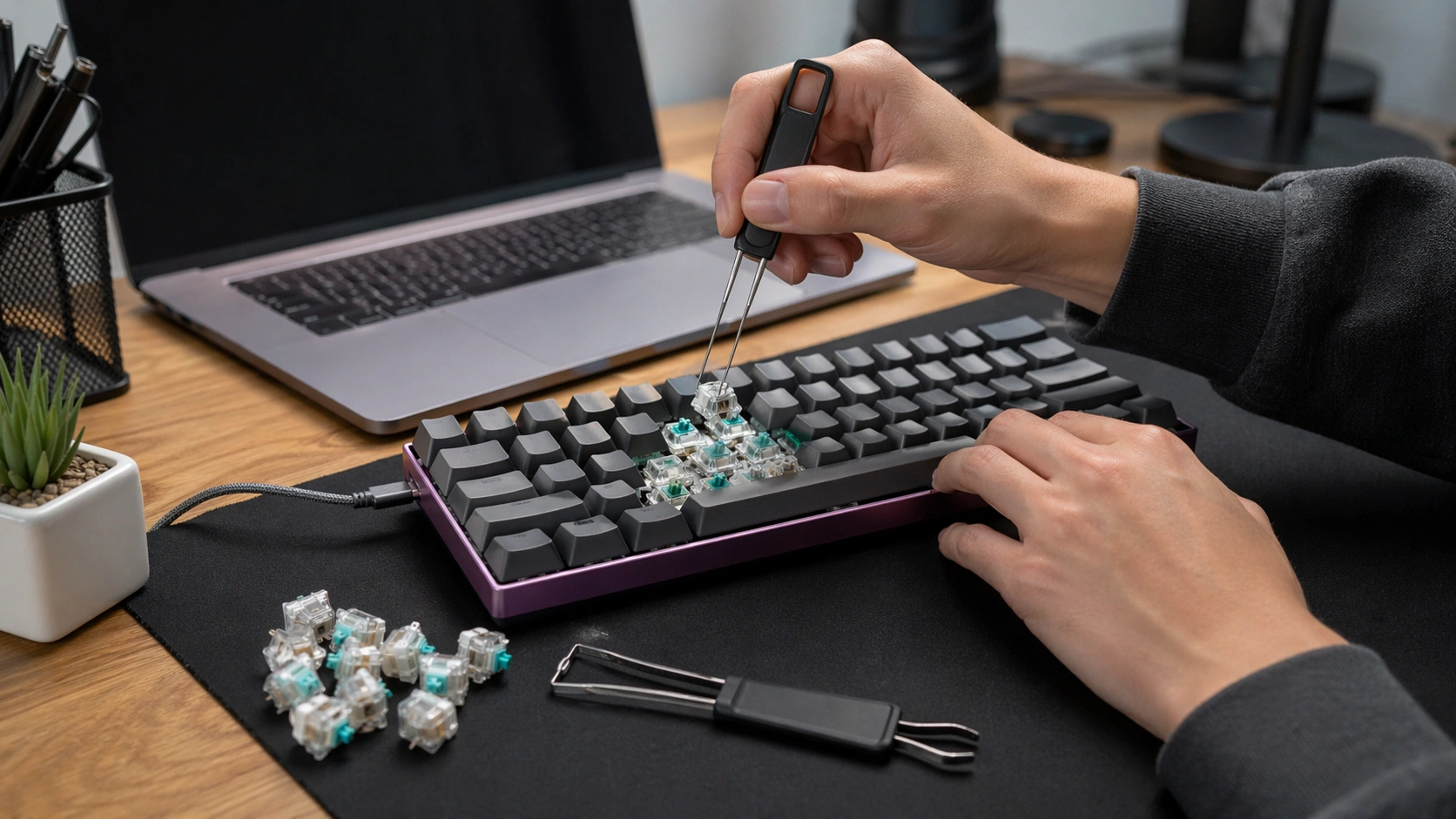
A 60 keyboard is a compact keyboard that removes the function row, number pad, navigation cluster, and often the arrow keys. It keeps the main typing area. That makes it small, clean, and great for a tight desk setup.
The switch count matters because each key usually needs one mechanical switch. If your keyboard has 61 keys, you need 61 switches. If you are building or upgrading a hot swap keyboard, buying the wrong number can stop your project halfway.
Why Most 60 Percent Keyboards Have 61 Switches
Most USA ANSI 60 percent keyboards have 61 keys. That means they need 61 switches. This is the most common answer for the keyword how many switches in a 60 keyboard.
| Keyboard Type | Common Key Count | Switches Needed |
|---|---|---|
| Standard ANSI 60% | 61 keys | 61 switches |
| ISO 60% | 62 keys | 62 switches |
| HHKB-style 60% | 60 to 64 keys | 60 to 64 switches |
| Custom 60% PCB | Varies | Count the installed keys |
Why Some 60 Keyboards Need 62, 63, or 64 Switches
Some 60 keyboards use a different bottom row, split Backspace, split right Shift, ISO Enter, or extra function keys. These changes can add one or more keys. That means you may need more than 61 switches.
My simple rule is this: do not guess from the product title alone. A “60 percent keyboard” is a size category, not a promise of exactly 60 switches.
How a 60 Keyboard Works: Keys, Switches, Stabilizers, and PCB Layout
A 60 keyboard has keycaps on top, switches under the keycaps, stabilizers under larger keys, a plate, and a PCB. The PCB is the circuit board that reads each key press and sends it to your computer.
For a deeper look at compact keyboard design, you can check examples from Keychron’s 60 percent keyboard documentation. You can also compare switch styles through Razer’s mechanical switch guide and compact gaming layouts from Logitech G’s 60 percent keyboard page.
Does Every Key Need One Switch?
Yes. In a normal mechanical keyboard, every working key needs one switch. If your 60 keyboard has 61 keys, it needs 61 switches.
The switch is the part that registers the press. The keycap is just the plastic top piece your finger touches.
Do Large Keys Like Spacebar Use More Than One Switch?
No. Large keys like the spacebar, Enter, Shift, and Backspace still use one switch each. They also use stabilizers to stop wobble.
This is a common beginner mistake. A spacebar may look wide, but it does not need five switches. It usually needs one switch and one stabilizer set.
Hot Swap vs Soldered 60 Keyboard Switches
A hot swap keyboard lets you pull switches out and push new ones in without soldering. A soldered keyboard needs soldering tools to remove or replace switches.
| Type | Best For | Switch Replacement |
|---|---|---|
| Hot swap 60 keyboard | Beginners, testers, home users | Easy with a switch puller |
| Soldered 60 keyboard | Advanced builders | Needs soldering and desoldering tools |
| Optical 60 keyboard | Gaming-focused setups | Needs compatible optical switches |
60 Keyboard Switch Count by Layout
The safest way to answer how many switches in a 60 keyboard is to check the layout. Most USA users with a standard ANSI 60 keyboard need 61 switches.
ANSI 60 Keyboard Switch Count
ANSI is the most common layout in the USA. It usually has a wide left Shift, horizontal Enter key, and 61 total keys. For this layout, buy at least 61 switches.
ISO 60 Keyboard Switch Count
ISO layouts often have a tall Enter key and an extra key near the left Shift. Many ISO 60 keyboards need 62 switches.
HHKB, WKL, and Custom 60 Layouts
Custom layouts can change the count. HHKB-style boards, WKL boards, split layouts, and custom PCBs may use different key positions. Some PCBs also support more switch positions than you actually install.
In that case, count the keys you plan to use. Do not count every socket on the PCB unless you are filling every socket.
Step-by-Step Guide: How to Know How Many Switches You Need
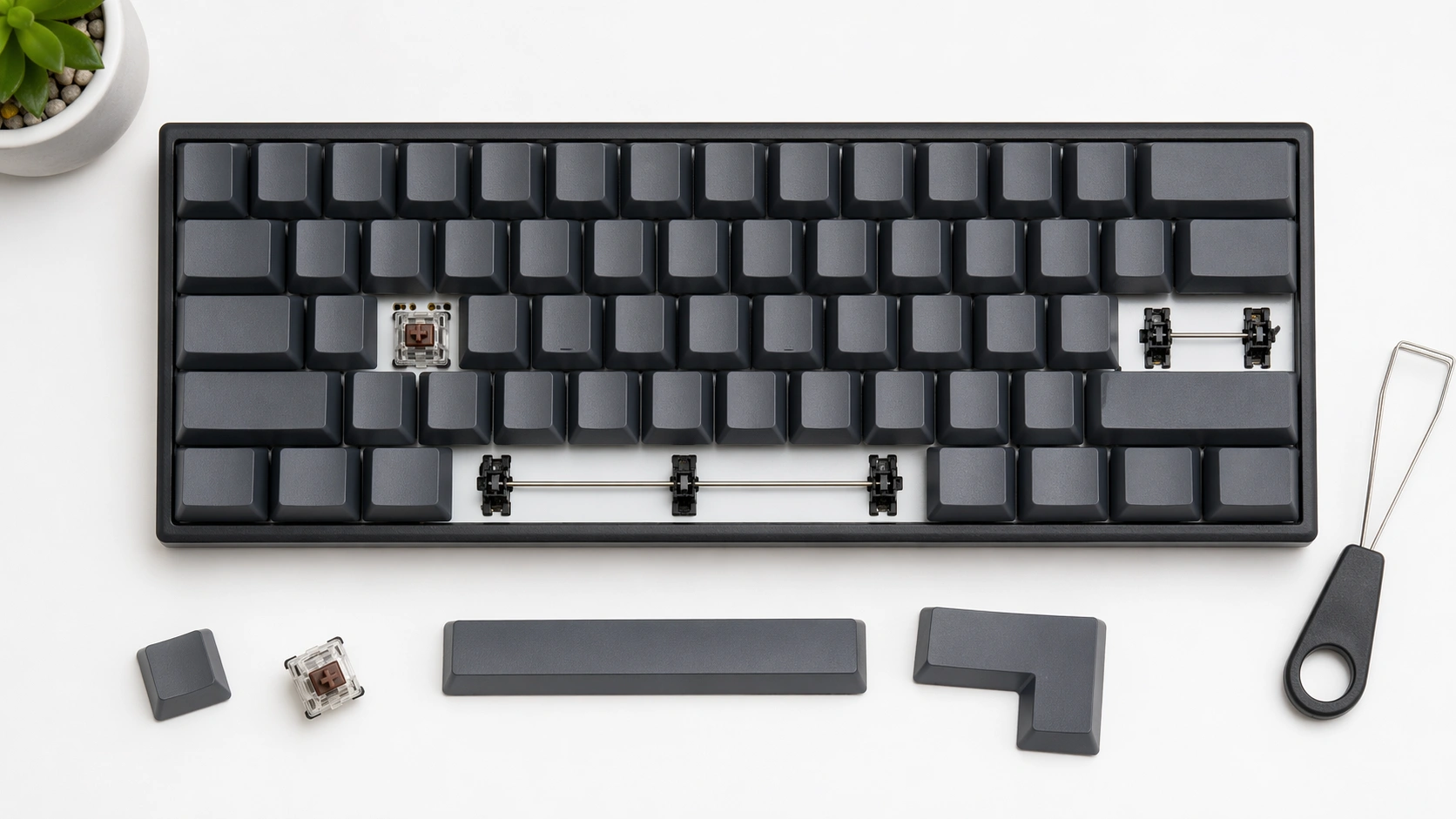
Here is the simple method I use when I help someone build or upgrade a compact keyboard.
Step 1: Count the Keys on Your Keyboard
Look at the physical keyboard or the layout diagram. Count each keycap position. Each key needs one switch.
- Count the letter keys.
- Count the number row.
- Count modifier keys like Ctrl, Alt, Shift, and Fn.
- Count large keys like Enter, Spacebar, and Backspace as one each.
- Add them together.
Step 2: Check If Your Board Is Hot Swappable
If your 60 keyboard is hot swappable, you can replace the switches with a switch puller. If it is soldered, you need soldering tools or professional help.
This matters because beginners often buy switches first and check the PCB later. That can lead to setup confusion.
Step 3: Match 3 Pin or 5 Pin Switch Compatibility
Many mechanical switches come in 3 pin or 5 pin designs. Some hot swap PCBs accept both. Some plates or PCBs may only fit 3 pin switches unless you clip the extra plastic legs.
| Switch Type | What It Means | Beginner Tip |
|---|---|---|
| 3 pin switch | Has fewer mounting legs | Fits many hot swap boards |
| 5 pin switch | Has extra plastic legs for stability | Check PCB support first |
| Optical switch | Uses light-based sensing | Only fits optical boards |
| Low-profile switch | Shorter switch design | Not for standard MX boards |
Step 4: Buy Extra Switches for Mistakes and Future Repairs
For a 61-key 60 keyboard, I suggest buying 70 switches if the pack size allows it. This gives you extra switches for bent pins, bad units, future testing, or one failed key later.
Most switch packs come in sets like 35, 45, 70, 90, or 110. For a 60 keyboard, a 70-pack is usually the safest choice.
60 Keyboard vs Other Keyboard Sizes: Full Comparison
A 60 keyboard saves desk space, but it removes dedicated keys. You use layers for arrows, function keys, Delete, and navigation controls.
| Keyboard Size | Common Switch Count | Best For | Main Tradeoff |
|---|---|---|---|
| 60% | 61 switches | Small desks, gaming, travel | Needs layers for arrows and function keys |
| 65% | 67 to 68 switches | Users who want arrows | Slightly wider |
| 75% | 80 to 84 switches | Office and productivity | Less compact |
| TKL | 87 switches | Gaming and work | No number pad |
| Full size | 104 to 108 switches | Data entry and office use | Takes more desk space |
Common Problems and Fixes When Replacing 60 Keyboard Switches
Switch replacement is simple on a hot swap board, but small problems can happen. Most are easy to fix if you know what to check.
Why Your 60 Keyboard Key Is Not Responding
If one key does not respond after a switch change, the switch pins may be bent, the switch may not be seated, or the hot swap socket may be damaged.
| Problem | Likely Cause | Quick Fix |
|---|---|---|
| One key not working | Bent switch pin | Pull the switch and straighten the pin |
| Key feels loose | Switch not fully seated | Press it evenly into the plate |
| Key double types | Switch chatter or dust | Try another switch or clean the socket |
| Keyboard not detected | USB cable, port, or firmware issue | Try another cable and port |
| Wireless keyboard disconnects | Low battery or signal interference | Charge it and move the dongle closer |
| Software not detecting board | Wrong app or unsupported firmware | Check the keyboard brand’s software page |
How to Fix Bent Switch Pins
Remove the switch slowly. Look at the bottom. If a metal pin is bent, gently straighten it with tweezers. Then line up the switch with the socket and press straight down.
Never force a switch into the PCB. If it does not go in smoothly, stop and check the pins.
Why Your Keyboard App or Software Is Not Detecting the Board
Some 60 keyboards use brand-specific apps. Others use VIA or QMK-based tools. If the app does not detect your keyboard, check the cable, browser permissions, firmware mode, and product support page.
This is common in office and workspace setups where the keyboard is connected through a hub, dock, or monitor USB port. Plug the keyboard directly into the computer during setup.
How to Fix Wireless or USB Connection Problems
For Bluetooth keyboards, remove the old pairing and pair again. For 2.4GHz keyboards, move the dongle closer. For wired boards, test another USB-C cable because some charging cables do not send data.
A compact keyboard does not use much power, but RGB lighting, wireless mode, and low battery can still cause odd failures.
Common 60 Keyboard Mistakes to Avoid
- Buying exactly 60 switches without checking the layout.
- Forgetting that most ANSI 60 keyboards need 61 switches.
- Counting stabilizers as extra switches.
- Buying optical switches for a mechanical PCB.
- Forcing 5 pin switches into an unsupported board.
- Pulling switches at an angle and bending pins.
- Using the wrong keyboard software during setup.
- Ignoring wireless battery and USB cable problems.
Best Switch Types for a 60 Keyboard Explained
The right switch depends on how you use the keyboard. A gaming setup, office desk, and writing workspace may all need different switch feel and sound.
Linear Switches for Gaming
Linear switches move straight down with no bump. They feel smooth and fast. Many gamers like them because they are easy to press quickly.
Tactile Switches for Typing
Tactile switches have a small bump during the press. I like them for writing, email, coding, and daily office use because the feedback helps me type with more control.
Clicky Switches for Feedback
Clicky switches make a clear click sound. They feel fun, but they can annoy people in shared rooms, offices, and late-night setups.
Quiet Switches for Office and Workspace Use
Quiet linear or quiet tactile switches are best for calls, shared desks, and home offices. If your keyboard is part of a clean workspace setup, quiet switches are often the safest choice.
| Switch Style | Feel | Noise | Best Use |
|---|---|---|---|
| Linear | Smooth | Low to medium | Gaming |
| Tactile | Small bump | Low to medium | Typing and office work |
| Clicky | Bump plus click | High | Personal use |
| Silent | Dampened press | Low | Shared workspace |
Tool Recommendations for 60 Keyboard Switch Replacement
You do not need a full repair bench to replace switches on a hot swap 60 keyboard. You do need the right small tools.
| Tool | Why You Need It | Beginner Advice |
|---|---|---|
| Switch puller | Removes switches safely | Use slow, even pressure |
| Keycap puller | Removes keycaps without damage | Wire pullers are usually better |
| Tweezers | Straightens bent pins | Use gently |
| USB-C data cable | Fixes many detection issues | Avoid charge-only cables |
| Small brush | Cleans dust from plate and PCB | Clean before installing switches |
Pro Tips and Best Practices from Real Keyboard Testing
- Buy 70 switches for a normal 61-key 60 keyboard.
- Test the keyboard before installing every keycap.
- Keep 3 to 5 spare switches in your desk drawer.
- Use quiet switches if you work near other people.
- Check the PCB before buying optical, low-profile, or 5 pin switches.
- Use a direct USB connection during firmware or app setup.
- Take a photo of your layout before removing keycaps.
Recommended Products for a 60 Keyboard Setup
Hot Swappable 60 Percent Mechanical Keyboard
A good choice if you want a compact board that lets you replace switches without soldering. Great for beginners, gamers, and small desk setups.
Mechanical Keyboard Switch Pack
Best for replacing worn switches, changing keyboard feel, or building a 60 keyboard. Choose a 70-pack when possible for a standard 61-key board.
Keycap and Switch Puller Tool Kit
A simple tool kit helps you remove keycaps and switches without damaging the plate, PCB, or switch pins.
FAQ: How Many Switches in a 60 Keyboard?
How many switches are in a 60 keyboard?
Most standard 60 keyboards have 61 switches. Some custom layouts may need 60, 62, 63, or 64 switches.
Do I need 60 or 61 switches for a 60 percent keyboard?
For most USA ANSI 60 percent keyboards, you need 61 switches. Buy 70 switches if you want safe extras.
Does the spacebar need more than one switch?
No. The spacebar uses one switch. It also uses stabilizers to keep the long key balanced.
Can I use any switches in a 60 keyboard?
No. You must match the switch type to your PCB. Standard MX-style, optical, low-profile, 3 pin, and 5 pin switches are not always interchangeable.
How many switches should I buy for a hot swap 60 keyboard?
Buy at least the exact key count. For a normal 61-key hot swap 60 keyboard, I recommend buying 70 switches.
Why is one key not working after I changed switches?
The most common cause is a bent switch pin. Remove the switch, straighten the pin, and reinstall it carefully.
Is a 60 keyboard good for office work?
Yes, if you like a compact desk setup and can use function layers. For spreadsheets or heavy navigation, a 65 percent, 75 percent, or TKL keyboard may feel easier.
Final Thoughts
The simple answer is that most 60 keyboards need 61 switches. But the smarter answer is to count your layout before buying. A 60 percent keyboard is a compact category, not an exact switch number.
If you are building or upgrading one, buy a few extra switches, check hot swap compatibility, and use the right puller tools. That keeps the process simple, safe, and beginner-friendly.
About Daniel Brooks
I’m Daniel Brooks. I test mechanical keyboards, workspace tech, smart devices, and practical computer accessories. My goal is to make tech setup simple, clear, and useful for real home and office users.